
On her 117th birthday on Sept 3, 2016, Google honoured Malaysian freedom fighter Sybil Medan Kathigasu with a dedicated doodle.

She is shown in her nurse’s uniform outside her former residence in Papan, Perak.
The patterned ribbon of the George Medal surrounds the doodle, a tribute to Kathigasu’s courageous contributions to the anti-occupation movement.
“On the 117th anniversary of Kathigasu’s birth,” Google said, “we remember and celebrate her tireless dedication to freedom.
“Thank you, Kathigasu, for your courage and the powerful legacy you’ve left behind.”
While we know that Sybil Kathigasu’s “war story” speaks of how her acts of courage during World War II had devastating consequences, not much is said of what her family had gone through.
History tells us she was married to Dr Abdon Clement Kathigasu at St John’s Cathedral in Kuala Lumpur and they had three children, a son (William whom they had adopted) and two daughters, Dawn and Olga.
After her parents had been arrested for resistance activities in 1943, Dawn was suspended over a fire and threatened with death unless her mother Sybil, who had already been tortured in vain, gave information about the guerillas.
The six year old, enduring her pain, implored her mother not to talk and was saved only by the intervention of a senior Japanese officer.
She later went to Britain to study medicine and is believed to have married and settled there.
A heart warming memory of Olga is relayed here by Deacon Dr Leslie Petrus.

“I first met Sybil’s eldest daughter Olga in 1971 when she moved into the house next to Matron Irene Stephens,” he recalls.
Stephens, Dr Petrus noted, was the matron-in-charge of women prisoners in Batu Gajah prison under the Japanese Government and Sybil was under her supervision.
“Matron Stephens, our close family friend, had retired from the Prisons Department in the mid- 60’s,” he added.
The deacon recalls Olga as “the lady in black.”
“She always wore a black dress with black shoes and a black veil and carried a black bag.
“She kept to herself and never talked to anyone or even smiled. I did not understand then, her unique character but I do now.”
His up close and personal experience with Olga was in 1972 when Queen Elizabeth, Prince Philip, and Princess Anne were on a royal visit to Malaysia and made a stopover at Penang.
“My mother,” he remembers,” decided to go and invited Matron Stephens and Olga to follow us.
“In a cramped Opel Record car, we were in Penang the whole day, and stood for few hours at Dewan Sri Pinang just to see them at the balcony.
“As we waved our handkerchiefs, she had a Union Jack flag, and wore a hat with the flag on it. I can still remember the first and only smile on her face. I sensed then she was proud of her mother as she carried the picture of her mum with the medal of George V for highest bravery. “
Later, that day, Dr Petruse said, Olga had wanted to see the Royal Brittania and he had to follow her into a small sampan boat, at the fishermen’s jetty, where Olga paid a premium price to a local fisherman for the ride.
“I could see her looking so intently and so connected. Even now, I can still remember how she never took her eyes off the ship, probably feeling grateful that her mother and her father were special people.
“As I recall that one day trip to Penang with her, (I was 13 years old then), I then knew why she always wore black.
“She had lost her father early 1972. With all that she had experienced since her childhood, she had kept the faith.
That day trip to Penang with Olga was described as a “blessing” by Dr Petruse.
“She was in deep pain and sadness. But she never showed it. Her silence each time I saw her spoke volumes of God’s grace and love.”
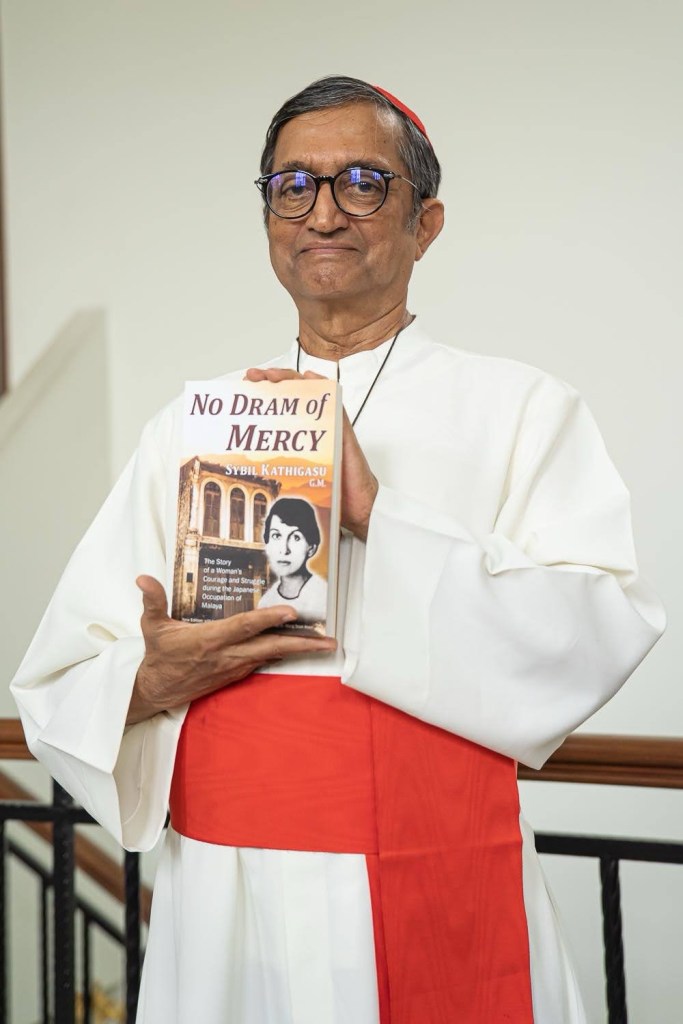
In her memoir `No Dram of Mercy’, Kathigasu or Mrs K as she was affectionately known to the people of Ipoh and Papan, Perak before and during World War II, tells a story of courage, compassion, defiance and faith.
As she offers a harrowing firsthand account of the Japanese occupation of Malaya during the war, she takes her readers into the chaos of the invasion and how her peaceful life as a nurse, wife, mother and daughter was disrupted.
This was a form of disruption which appeared to transcend just mere inconvenience; it becomes a brutal struggle for survival under oppressive Japanese rule.
As a nurse and a staunch supporter of the Malayan resistance against Japanese occupation, Kathigasu’s life is a powerful narrative of sacrifice, courage, and commitment to humanitarian principles.
The push for her beatification within the Catholic Church highlights her exemplary virtues and profound moral integrity, confirming her legacy as a beacon of hope in times of darkness.
“Her faith in God as a Catholic and a disciple of Christ is the primary orientation the Diocese of Penang is pursuing,” its bishop Cardinal Sebastian Francis said in an interview.

Cardinal Sebastian Francis with Sybil Kathigasu’s memoir ‘No Dram of Mercy’ (picture by Boon Tiong)
“Our focus is on her perseverance and fidelity to her profession as a nurse to the Florence Nightingale Pledge,” he added.
The pledge which is named in honour of the founder of modern nursing – Florence Nightingale – states:
“I solemnly pledge myself before God, and in the presence of this assembly, to pass my life in purity and to practise my profession faithfully.”
Cardinal Sebastian also said that the diocese will focus on Kathigasu’s courage and valour, to undergo persecution and suffering in her career as a nurse, and being honoured with the George Medal for bravery in 1947.
(She is the only Malayan woman ever to be awarded the George Medal. The George Medal (GM), instituted on 24 September 1940 by King George VI, is a decoration of the United Kingdom and Commonwealth, awarded for gallantry, typically by civilians, or in circumstances where military honours are not appropriate.)
Kathigasu died in 1948 and was buried at the cemetery in the Church of St. Michael in Ipoh, Perak.

Sybil Kathigasu’s final resting place in the grounds of St Michael’s Church, Ipoh (picture by Daniel Roy Santiyagu)
The Cardinal is also appealing to those with any information, photographs or any research on Sybil to forward these to Daniel Roy Santiyagu who is the head for social communication for the Diocese of Penang at: socialcomm@pgdiocese.org
Born in 1910 in Ipoh, Perak, Sybil Kathigasu was a trained nurse who, along with her husband, played a crucial role in providing medical care to resistance fighters during the Japanese occupation of Malaya from 1942 to 1945. Kathigasu’s work with the underground organization, known as the “Malayan People’s Anti-Japanese Army,” exemplified her courage as she operated in tremendous danger, often risking her life and those of her family for the greater good.
During the war, she not only offered essential medical assistance but also acted as a source of intelligence. Her contributions were instrumental in the efforts to undermine the occupying forces. Her actions reflect a selfless devotion to her fellow countrymen and a passionate commitment to justice, making her a symbol of resistance against tyranny.
The Diocese of Penang has officially opened the cause of beatification and canonization for Kathigasu, whom Sebastian said continues to inspire people even 76 years after her death.
“I see this as an opportunity to bring together and reflect on her life for us as people of faith,” said the cardinal.
While she was born in Medan, Indonesia, the story of this daughter of Malaysia unfolds in cities and towns in Perak like Papan (where she and her husband Dr Abdon Clement ran a clinic), Batu Gajah (where she was incarcerated) and the her final resting place, which is the cemetery in the grounds of St Michael’s Church in Ipoh.
“Groups are already visiting these places,” notes the cardinal, “including the Church of St Joseph in Batu Gajah, where one of its wings is dedicated to Sybil’s memory.”
Upon her release from prison, Kathigasu’s request was to be taken to St Joseph’s Church immediately to offer her thanksgiving.
Asked on what could be a potentially high cost to pursue her beatification, the cardinal said:
“We will cross that bridge when we get there. We do not start by talking about money.”
In questioning the choice of Kathigasu by some parties for impending sainthood, Cardinal Sebastian said the process itself, with its appointed moderator will question this and other concerns.
“It is normal to expect people to question her suitability (for beatification),” he added.
Ends.
 postcodegeorgetown
There is a road in Fair Park, Ipoh, named after Sybil Kartigasu.
LikeLiked by 1 person