Kim, a vibrant and colourful soul whose love for fabric and textiles was matched by her passion for travel and devotion to music, has left us after an illness.
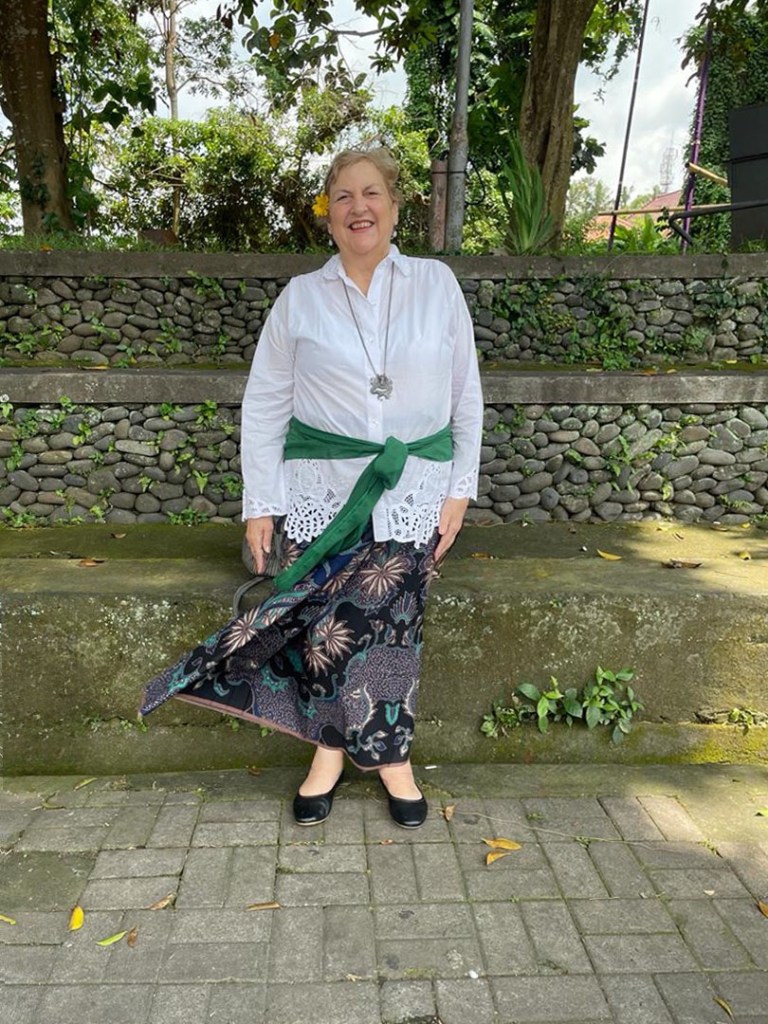
Kim at one of her favourite travel destinations (Bali) this year (photo by Tess tweaked by Boon Tiong)
Her creative spirit shone brightly through her work with textiles which saw the production of a book.
The book authored by Kim
An avid traveler, Kim, embarked on countless adventures, exploring new cultures and gathering inspiration for her work, as she set up homes with her late husband Michael Saunders, in various Asian cities. She cherished every journey, finding joy in discovering new places, meeting new friends, and experiencing the beauty of the world.
Her devotion and love for dogs is legendary and she will be remembered for always being the first to lend a hand and donation to those in need.
Kim’s love for music, particularly choral singing, enriched her life and the lives of those around her.
Whether performing in local choirs or sharing her love of music for God in church, her voice resonated always with passion and joy. She found solace and connection through song and hymns, and her spirit will undoubtedly echo in the hearts of those who sang alongside her.
Kim sang in the Church of the Immaculate Conception, Penang’s choir
Now, Kim is reunited with her beloved Michael, and together they continue their journey in the beyond. May their love inspire us to embrace our passions and cherish every moment.
Rest in peace, Kim. Your legacy of love, service and inspiration will be etched in all our hearts.
On her 117th birthday on Sept 3, 2016, Google honoured Malaysian freedom fighter Sybil Medan Kathigasu with a dedicated doodle.
A doodle by Google to honour Sybil Medan Kathigasu
She is shown in her nurse’s uniform outside her former residence in Papan, Perak.
The patterned ribbon of the George Medal surrounds the doodle, a tribute to Kathigasu’s courageous contributions to the anti-occupation movement.
“On the 117th anniversary of Kathigasu’s birth,” Google said, “we remember and celebrate her tireless dedication to freedom.
“Thank you, Kathigasu, for your courage and the powerful legacy you’ve left behind.”
While we know that Sybil Kathigasu’s “war story” speaks of how her acts of courage during World War II had devastating consequences, not much is said of what her family had gone through.
History tells us she was married to Dr Abdon Clement Kathigasu at St John’s Cathedral in Kuala Lumpur and they had three children, a son (William whom they had adopted) and two daughters, Dawn and Olga.
After her parents had been arrested for resistance activities in 1943, Dawn was suspended over a fire and threatened with death unless her mother Sybil, who had already been tortured in vain, gave information about the guerillas.
The six year old, enduring her pain, implored her mother not to talk and was saved only by the intervention of a senior Japanese officer.
She later went to Britain to study medicine and is believed to have married and settled there.
A heart warming memory of Olga is relayed here by Deacon Dr Leslie Petrus.
Rev Deacon Dr Leslie Petrus (image from the Malacca Johore Diocese website)
“I first met Sybil’s eldest daughter Olga in 1971 when she moved into the house next to Matron Irene Stephens,” he recalls.
Stephens, Dr Petrus noted, was the matron-in-charge of women prisoners in Batu Gajah prison under the Japanese Government and Sybil was under her supervision.
“Matron Stephens, our close family friend, had retired from the Prisons Department in the mid- 60’s,” he added.
The deacon recalls Olga as “the lady in black.”
“She always wore a black dress with black shoes and a black veil and carried a black bag.
“She kept to herself and never talked to anyone or even smiled. I did not understand then, her unique character but I do now.”
His up close and personal experience with Olga was in 1972 when Queen Elizabeth, Prince Philip, and Princess Anne were on a royal visit to Malaysia and made a stopover at Penang.
“My mother,” he remembers,” decided to go and invited Matron Stephens and Olga to follow us.
“In a cramped Opel Record car, we were in Penang the whole day, and stood for few hours at Dewan Sri Pinang just to see them at the balcony.
“As we waved our handkerchiefs, she had a Union Jack flag, and wore a hat with the flag on it. I can still remember the first and only smile on her face. I sensed then she was proud of her mother as she carried the picture of her mum with the medal of George V for highest bravery. “
Later, that day, Dr Petruse said, Olga had wanted to see the Royal Brittania and he had to follow her into a small sampan boat, at the fishermen’s jetty, where Olga paid a premium price to a local fisherman for the ride.
“I could see her looking so intently and so connected. Even now, I can still remember how she never took her eyes off the ship, probably feeling grateful that her mother and her father were special people.
“As I recall that one day trip to Penang with her, (I was 13 years old then), I then knew why she always wore black.
“She had lost her father early 1972. With all that she had experienced since her childhood, she had kept the faith.
That day trip to Penang with Olga was described as a “blessing” by Dr Petruse.
“She was in deep pain and sadness. But she never showed it. Her silence each time I saw her spoke volumes of God’s grace and love.”
In her memoir `No Dram of Mercy’, Kathigasu or Mrs K as she was affectionately known to the people of Ipoh and Papan, Perak before and during World War II, tells a story of courage, compassion, defiance and faith.
As she offers a harrowing firsthand account of the Japanese occupation of Malaya during the war, she takes her readers into the chaos of the invasion and how her peaceful life as a nurse, wife, mother and daughter was disrupted.
This was a form of disruption which appeared to transcend just mere inconvenience; it becomes a brutal struggle for survival under oppressive Japanese rule.
As a nurse and a staunch supporter of the Malayan resistance against Japanese occupation, Kathigasu’s life is a powerful narrative of sacrifice, courage, and commitment to humanitarian principles.
The push for her beatification within the Catholic Church highlights her exemplary virtues and profound moral integrity, confirming her legacy as a beacon of hope in times of darkness.
“Her faith in God as a Catholic and a disciple of Christ is the primary orientation the Diocese of Penang is pursuing,” its bishop Cardinal Sebastian Francis said in an interview.
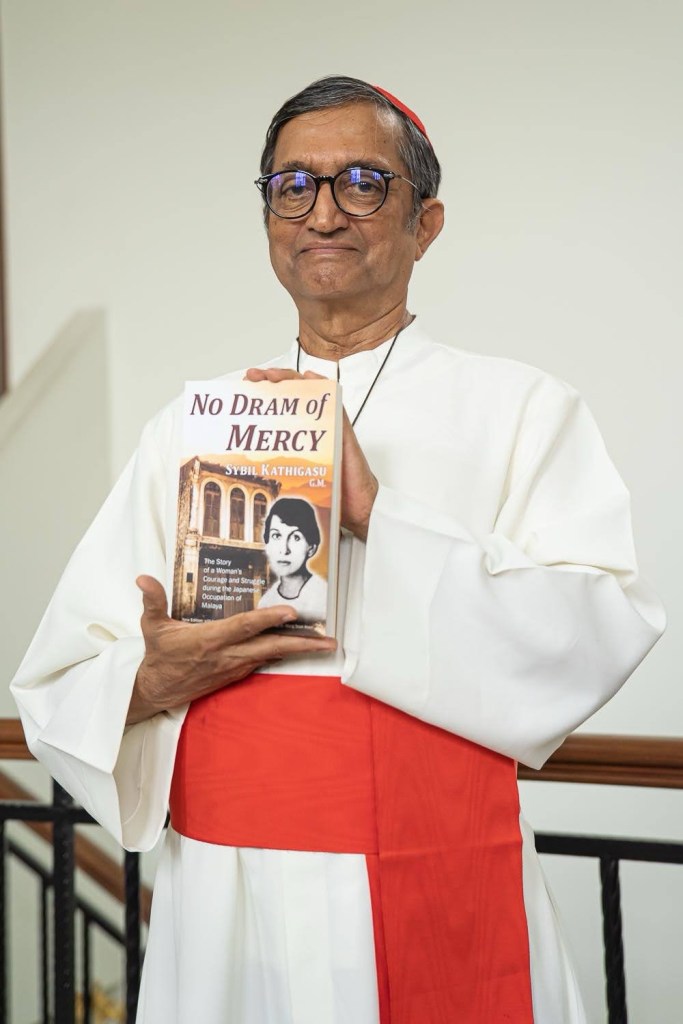
Cardinal Sebastian Francis with Sybil Kathigasu’s memoir ‘No Dram of Mercy’ (picture by Boon Tiong)
“Our focus is on her perseverance and fidelity to her profession as a nurse to the Florence Nightingale Pledge,” he added.
The pledge which is named in honour of the founder of modern nursing – Florence Nightingale – states:
“I solemnly pledge myself before God, and in the presence of this assembly, to pass my life in purity and to practise my profession faithfully.”
Cardinal Sebastian also said that the diocese will focus on Kathigasu’s courage and valour, to undergo persecution and suffering in her career as a nurse, and being honoured with the George Medal for bravery in 1947.
(She is the only Malayan woman ever to be awarded the George Medal. The George Medal (GM), instituted on 24 September 1940 by King George VI, is a decoration of the United Kingdom and Commonwealth, awarded for gallantry, typically by civilians, or in circumstances where military honours are not appropriate.)
Kathigasu died in 1948 and was buried at the cemetery in the Church of St. Michael in Ipoh, Perak.
Sybil Kathigasu’s final resting place in the grounds of St Michael’s Church, Ipoh (picture by Daniel Roy Santiyagu)
The Cardinal is also appealing to those with any information, photographs or any research on Sybil to forward these to Daniel Roy Santiyagu who is the head for social communication for the Diocese of Penang at: socialcomm@pgdiocese.org
Born in 1910 in Ipoh, Perak, Sybil Kathigasu was a trained nurse who, along with her husband, played a crucial role in providing medical care to resistance fighters during the Japanese occupation of Malaya from 1942 to 1945. Kathigasu’s work with the underground organization, known as the “Malayan People’s Anti-Japanese Army,” exemplified her courage as she operated in tremendous danger, often risking her life and those of her family for the greater good.
During the war, she not only offered essential medical assistance but also acted as a source of intelligence. Her contributions were instrumental in the efforts to undermine the occupying forces. Her actions reflect a selfless devotion to her fellow countrymen and a passionate commitment to justice, making her a symbol of resistance against tyranny.
The Diocese of Penang has officially opened the cause of beatification and canonization for Kathigasu, whom Sebastian said continues to inspire people even 76 years after her death.
“I see this as an opportunity to bring together and reflect on her life for us as people of faith,” said the cardinal.
While she was born in Medan, Indonesia, the story of this daughter of Malaysia unfolds in cities and towns in Perak like Papan (where she and her husband Dr Abdon Clement ran a clinic), Batu Gajah (where she was incarcerated) and the her final resting place, which is the cemetery in the grounds of St Michael’s Church in Ipoh.
“Groups are already visiting these places,” notes the cardinal, “including the Church of St Joseph in Batu Gajah, where one of its wings is dedicated to Sybil’s memory.”
Upon her release from prison, Kathigasu’s request was to be taken to St Joseph’s Church immediately to offer her thanksgiving.
Asked on what could be a potentially high cost to pursue her beatification, the cardinal said:
“We will cross that bridge when we get there. We do not start by talking about money.”
In questioning the choice of Kathigasu by some parties for impending sainthood, Cardinal Sebastian said the process itself, with its appointed moderator will question this and other concerns.
“It is normal to expect people to question her suitability (for beatification),” he added.
Cardinal Sebastian Francis, Bishop of Penang (picture by Boon Tiong)
In the heart of George Town, an island rich in cultural diversity and spiritual heritage, two pipe organ recitals took place over two weekends, uniting communities through the shared language of music.
Although these recitals were held in different churches and featured the (almost) same musical repertoire, they served as a tribute to the spirit of Malaysia—an intricate tapestry woven from various backgrounds, traditions, and beliefs.
The first recital unfolded last weekend at the Anglican St. George’s Church , an architectural marvel that stands as a testament to the nation’s colonial past.
The grand organ, with its majestic pipes soaring high within the heritage church’s interior, filled the air with glorious harmonies.
The recital was attended by a diverse audience, ranging from devoted parishioners to curious music lovers eager to experience the power of the organ.
As the notes danced around the church’s ceilings, there was an undeniable sense of reverence and community.
Meanwhile, just a few kilometers away, a similar concert took place today at the Roman Catholic Church of The Assumption, which is home to the country’s oldest pipe organ.
The organ in this church, affectionately called ‘The Old Lady’ resonated with the same passion and brilliance of its neighbouring church, filling the sacred space with music that transcended boundaries.
Although the music played in both churches was almost the same—classical masterpieces and contemporary and local compositions that echoed the human experience—the backgrounds of the attendees highlighted the multicultural essence of Malaysia.
In both these spaces, people from various ethnicities and religions came together, their hearts beating in sync with the rhythm of the music.
This shared experience mirrors the greater narrative of Malaysia, a nation built upon co-existence. Just as the two recitals united different communities under the canopy of music, Malaysia thrives on a foundation of harmony, drawing from its rich tapestry of Malay, Chinese, Indian, and Indigenous cultures.
Each community contributes its own unique flavour, from the spices in its cuisine to the festivals that fill the calendar, painting a vibrant picture of unity amid diversity.
Music, particularly through the majestic pipe organ, has an incredible ability to evoke emotions and bridge gaps. The organ’s powerful sounds resonate with the soul, reminding us of our shared humanity—something both recitals amplified.
Additionally, the very act of coming together to appreciate art, serves as a reminder of the potential for collaboration and dialogue in a multi-cultural society. In a world that often highlights divisions, events like these reflect the collective aspiration of Malaysians to embrace a harmonious future.
Kudos George Town Festival 2024 for featuring these two pipe organ recitals. They have served as beautiful reminders that, despite our differences, we can find common ground through the universal language of music.
As we look forward to more such events (hopefully through dedicated efforts of the event’s curator, Leonard Selva Gurunathan), let’s continue to celebrate the rich culture that is uniquely Malaysian, a melody played on the grand organ of humanity itself.
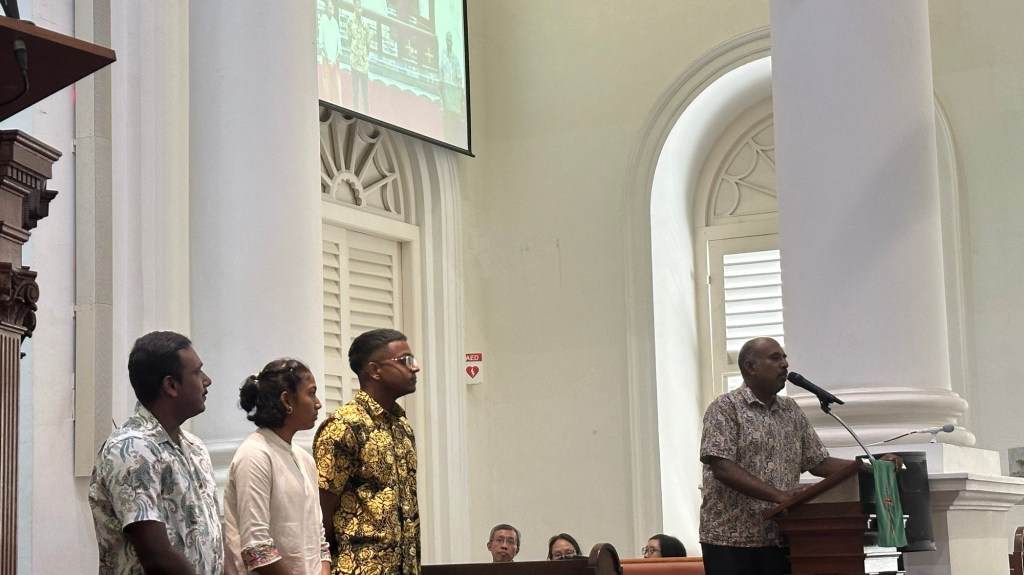
Syabas to Matthew Arwinraj Jaya Paul, Daniel Joel De Costa, Victor Cheah Eu Jin, Jason William and Hannah Thoraisingam for uniting us all with your musical notes!
From left: Leonard, Hannah, Jason & Matthew (courtesy pix Leonard Selva Gurunathan)
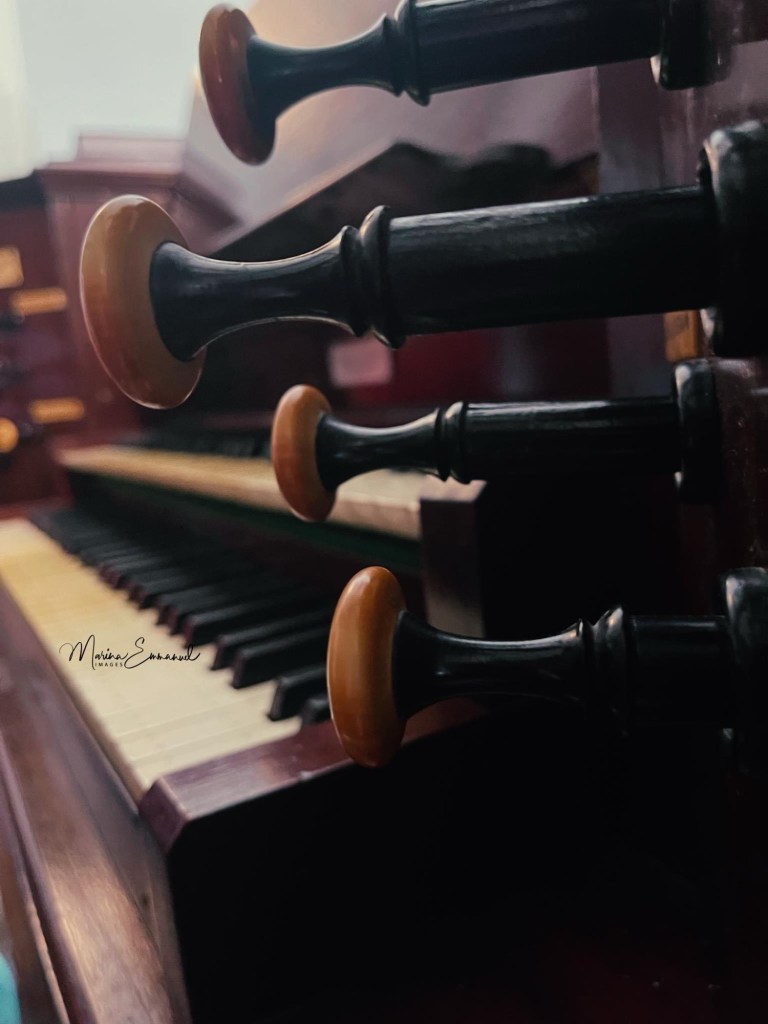
For many young musicians, the pipe organ is a daunting and complex instrument. With its massive size, myriad of keys and stops, and powerful sound, it can be intimidating for even the most seasoned musician. However, for those who are willing to put in the time and effort, the pipe organ can be an incredibly rewarding and fulfilling instrument to play.
Leonard on the pipe organ at St George’s Church
Young musicians Matthew Arwinraj Jaya Paul, Jason William and Hannah Thoraisingam seem to have found a good teacher in Leonard Selva Gurunathan in helping them navigate the complexities of this intricate instrument.
A free lunchtime pipe organ recital yesterday at St George’s Church in Penang was a good show that they are on the way to becoming very proficient pipe organ players.
One of the most inspiring things about learning to play the pipe organ is the rich history and tradition that surrounds this instrument.
Matthew with proud grandmum, Rani Rajamoney
The pipe organ has been a staple of Western music for centuries, and has been used in churches, concert halls, and even in popular music.
By mastering this organ, this group of young people are well on their way to being a part of this rich tradition and carrying on a legacy that spans generations.
Leonard and Jason
The latest edition of the George Town Festival has provided an opportunity for Leonard and young pipe organists in Penang to showcase their talent and inspire audiences from all walks of life with their passion for music.
If you happen to be a young pipe organist or nursing aspirations to be one (regardless of age!) there is still one more free recital during this annual arts festival to enjoy and be further inspired by.
See you next Saturday (July 27) at 1pm in the Church of the Assumption along Lebuh Farquhar.
Church of the Assumption
This heritage Roman Catholic church, is home to the country’s oldest pipe organ, where its resident organist and fierce custodian of the instrument, is Leonard.
Join him and his pipe organists as they take you on a (keyboard) journey of Malaysian music and those from around the world, as they try and inspire more people in Penang and elsewhere to make a home for and support the upkeep of pipe organs, while placing Malaysian talents on the world map of pipe organs.
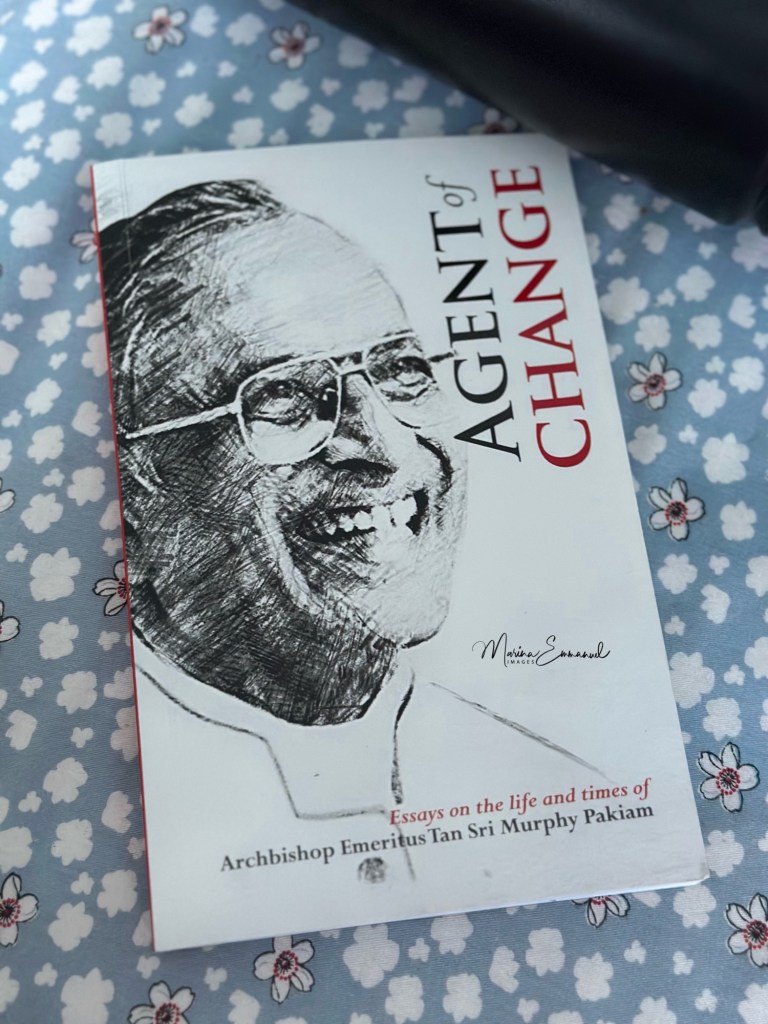
A chapter is dedicated to Sybil in the book “Agent of Change – Essays on the life and times of Archbishop Emeritus Tan Sri Murphy Pakiam”
Malaysia has a candidate for sainthood. While many claim they have no clue of who Sybil Medan Kathigasu is, others have brief recollections of her in their History textbooks.
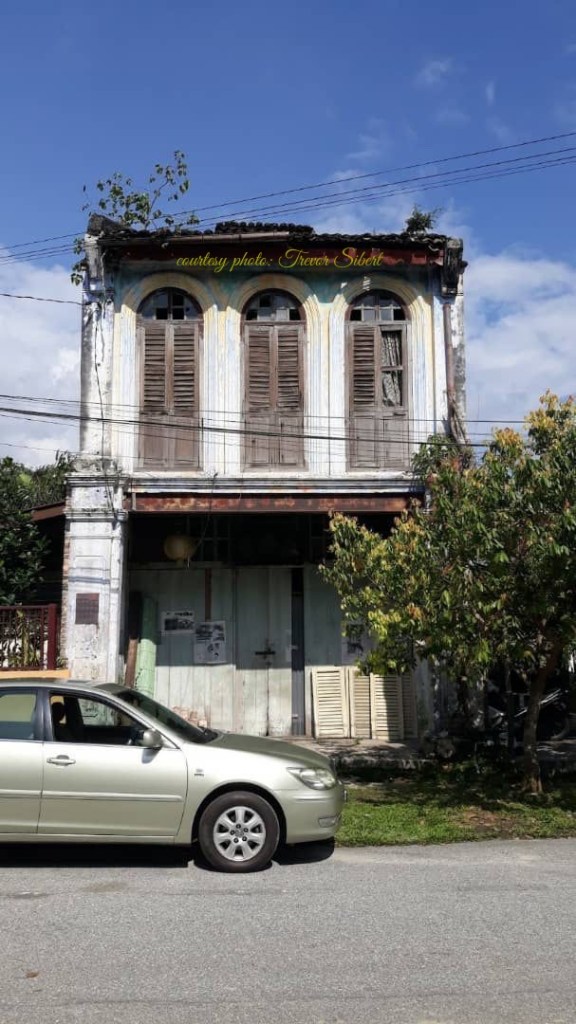
Sybil is also the only Malayan woman to receive the British Crown’s George Medal for covertly supplying medicine, medical services and refuge to resistance fighters from her home (a shophouse in Papan, Perak) for years during World War II.
The shophouse in Papan, Perak where Sybil worked and lived.
Her legacy is also found in Roman Catholic cathecism books, a movie (Sybil Kathigasu – Apa Dosa Ku), a book she penned “No Dram of Mercy”, while a chapter is dedicated to her in a new book, “Agent of Change – Essays on the life and times of Archbishop Emeritus Tan Sri Murphy Pakiam.”
(The former archbishop who grew up in Batu Gajah, Perak where Sybil was incarcerated during the war, had a strong desire for her to become Malaysia’s first saint, because of his growing years and stories of her faith and courage which were relayed by family and friends.)
“Apart from my dad serving her medically while she was in prison, I feel strongly that Sybil should be made a saint as she has served as a faithful person who sacrificed so many things for the church’s sake and the community around her at the time can attest to it,” Archbishop Emeritus Murphy says in “Agent of Change.”
“Why I chose Sybil,” says Cardinal Sebastian Francis in the book , “is because she is a woman, a lay person (and not a cleric), a wife and mother and also a professional.”
“For the Catholic church,” notes Sebastian, who is also Bishop of Penang, “we are unique and are not taken up by stories of courage.”
“We (the Penang Diocese) have commenced with the collection of data and initial steps for the process of canonisation of (a saint from our soil).
“It is pretty obvious from the initial data that I have received and other sources of information that Sybil was a courageous freedom fighting heroine and we are reasonably convinced that we should proceed with (her canonization).”
His Eminence Cardinal Datuk Seri Sebastian Francis (left) is calling for Sybil’s beatification and canonisation
A movie titled “Sybil” is also reportedly in the making, while an opera “Solace of Papan” is set to open in Selangor this month.
The road to sainthood is a long, complex and expensive one and all help is needed in crafting a memorable and meaningful “brand” for potential candidates.
What qualities and characteristics do or did our potential saint embody? How can we best represent Sybil’s life and achievements through branding?
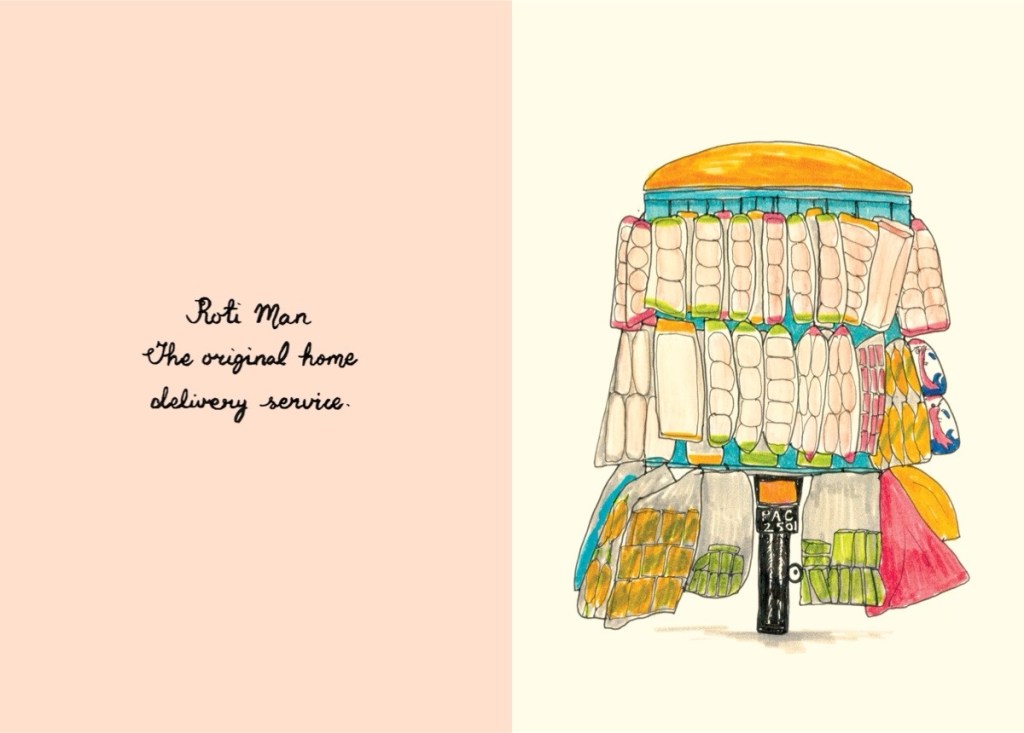
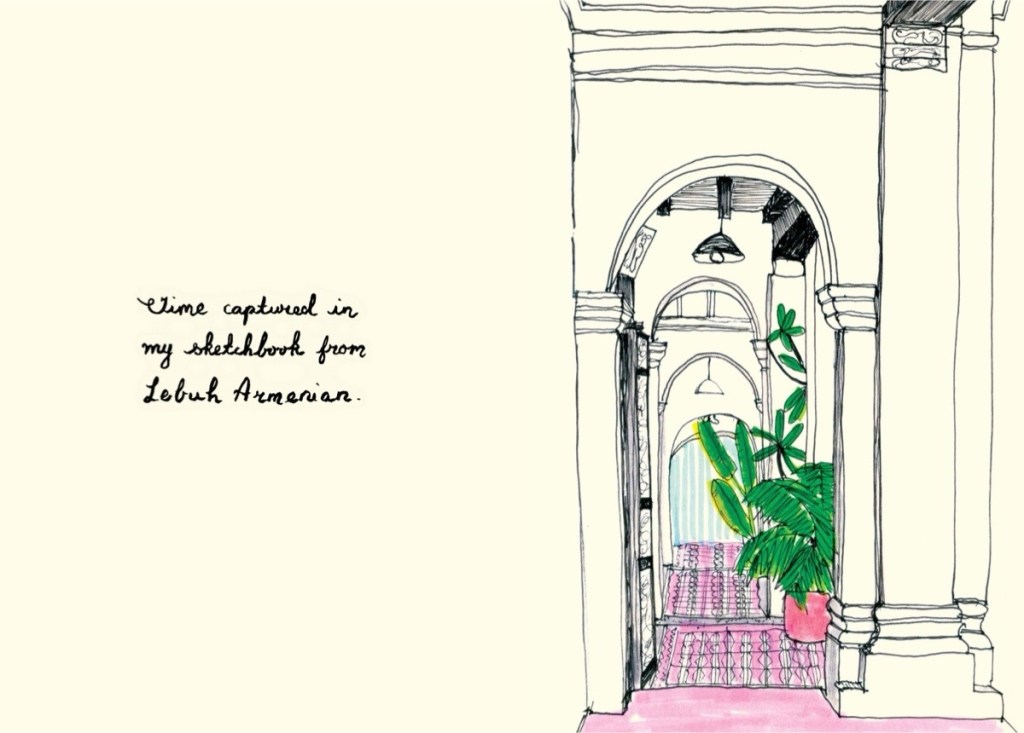
A decade ago, Penang-born Tiffany Choong began sketching daily in her art journal, as part of her Happiness Project.
The self-taught artist discovered the joys of sketching through her global travels, which in turn it is said, gives her “a sense of purpose that fuels her soul.”
Just in time for Christmas, Tiffany presents EVERYDAY PENANGThe Art of Joy.
She delivers playful pen and ink sketches, having drawn inspiration from simple objects she takes in daily.
Each sketch takes the reader not only into the “inner Penang” through the eyes of the artist, but is also paired with little pick-me-up quotes and words of wisdom along the way.
The visual treats found on every page of the compact book, is one which will spark joy with Penang residents and Penangites-at-heart, thanks to boutique publisher Clarity Publishing, who has connected Tiffany’s hometown and heritage with themes of love, loss and identity, including traditions and rituals.
As we wind up 2023 with an attitude of gratitude, the book serves as a gentle and colourful reminder to ourselves that “the simple joys of life will always shine through, if we let them.”
Courtesy photo Christopher Jude AnthonyCourtesy photo Dennis AuCourtesy photo Dennis Au
Roman Catholics in Malaysia and beyond have been beaming with gratitude and pride today in giving thanks for a special gift.
Penang Bishop Sebastian Francis has been elevated to the ranks of a Cardinal, a big honour and win for this country and Asia.
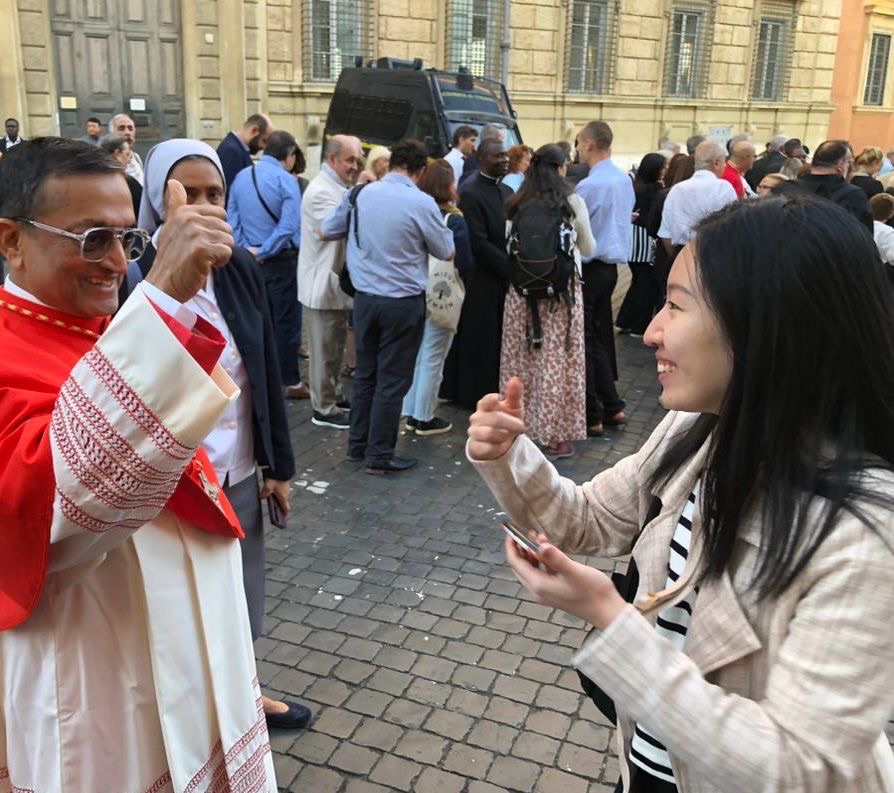
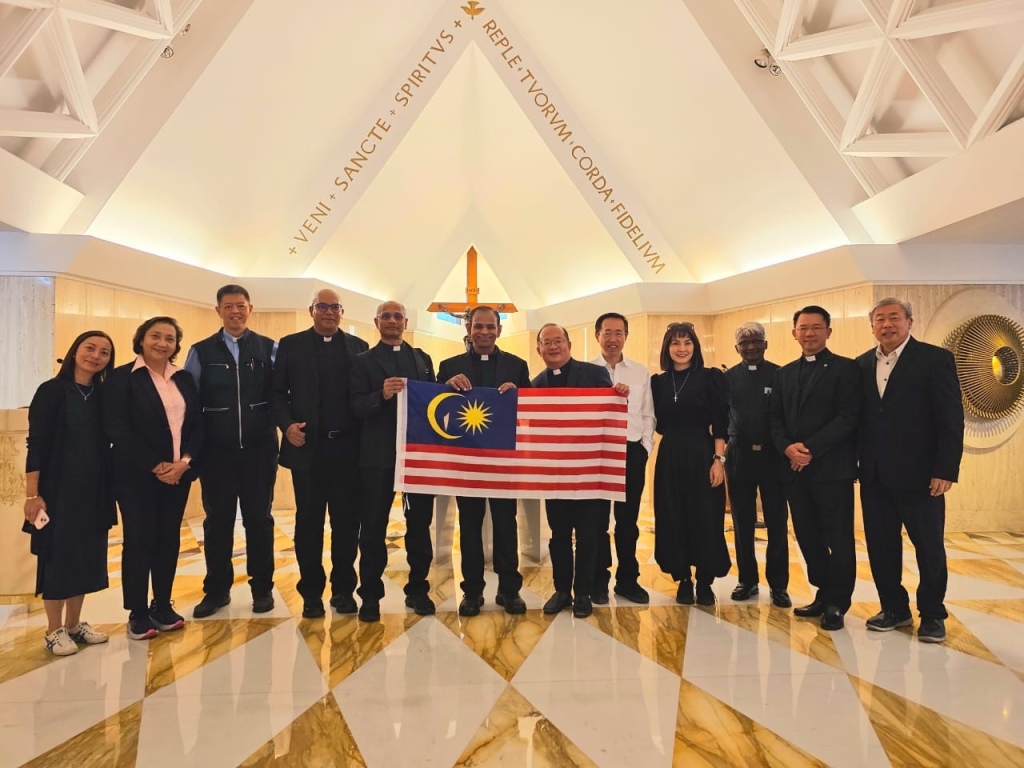
As Malaysians at St Peter’s Square in the Vatican gathered today and waved the Jalur Gemilang, they have carried the pride of all Catholics from the Penang Diocese and the rest of the country in celebrating a newly-minted cardinal who has always been one to promote inclusion and celebrates harmony and diversity.
Courtesy photo Bernadette LauCourtesy photo Monsignor Jude MirandaCourtesy photo Christopher Jude Anthony Courtesy photo Rev Father Aloysius Tan
The Holy Father sums today’s happenings best below …
HOMILY OF HIS HOLINESS POPE FRANCIS
Saint Peter’s Square Saturday, 30 September 2023
____________________________
Thinking of this celebration and particularly of you, dear brothers, who would become Cardinals, a text from the Acts of the Apostles came to mind (cf. 2:1-11). It is a fundamental text: the story of Pentecost, the baptism of the Church… But my thoughts were really drawn to one detail: the expression spoken by the Jews who “were dwelling in Jerusalem” (v. 5). They said: We are “Parthians and Medes and Elamites” (v. 9) and so on. This long list of peoples made me think of the Cardinals, who thanks be to God, are from all parts of the world, from the most diverse nations. That is the reason I chose this biblical passage.
Meditating on this, I became aware of a kind of “surprise” hidden in this association of ideas, a surprise in which, with joy, I seemed to recognize the humor of the Holy Spirit, so to speak. Please excuse the expression.
What is this “surprise”? It consists in the fact that normally we pastors, when we read the account of Pentecost, identify ourselves with the Apostles. It is natural to do so. Instead, those “Parthians, Medes, Elamites” et cetera, associated in my mind with the Cardinals, do not belong to the group of disciples. They are outside the Upper Room; they are part of the “crowd” that “gathered” upon hearing the noise of the rushing wind (cf. v. 6). The Apostles were “all Galileans” (cf. v. 7), while the people who gathered were “from every nation under heaven” (v. 5), just like the Bishops and Cardinals of our time.
This kind of role reversal gives us pause for thought and, when we look closely, it reveals an interesting perspective, which I would like to share with you. It is a matter of applying to ourselves – I will put myself first – the experience of those Jews who by a gift of God found themselves protagonists of the event of Pentecost, that is of the “baptism” by the Holy Spirit that gave birth to the One, Holy, Catholic and Apostolic Church. I would summarize the perspective in this way: to rediscover with amazement the gift of having received the Gospel “in our own tongues” (v.11), as the Jews said. To think back with gratitude on the gift of having been evangelized and having been drawn from various peoples who, each in their own time received the Kerygma, the proclamation of the mystery of salvation, and in welcoming it, were baptized in the Holy Spirit and became part of the Church. Mother Church, who speaks all languages, is One and is Catholic.
This word from the Acts of the Apostles makes us reflect that, before being “apostles”, before being priests, Bishops, Cardinals, we are “Parthians, Medes, Elamites”, et cetera, et cetera. And this should awaken awe and gratitude in us for having received the grace of the Gospel among our respective peoples of origin. I think this is very important and not to be forgotten. Because there, in the history of our people, I would say in the “flesh” of our people, the Holy Spirit has worked the wonder of communicating the mystery of Jesus Christ who died and rose again. And this came to us “in our language”, from the lips and the gestures of our grandparents and our parents, of catechists, priests, and religious… Every one of us can remember concrete voices and faces. The faith is transmitted “in dialect”. Don’t forget this: the faith is transmitted in dialect, by mothers and grandmothers.
Indeed, we are evangelizers to the extent we cherish in our hearts the wonder and gratitude of having been evangelized, even of being evangelized, because this is really a gift always present, that must be continually renewed in our memories and in faith. Evangelizers who have been evangelized, not functionaries.
Brothers and sisters, dearest Cardinals, Pentecost – like the Baptism of each one of us – is not a thing of the past; it is a creative act that God continually renews. The Church – and each of her members – lives this ever-present mystery. She does not live “off of her name”, still less does she live off of an archeological patrimony, however precious and noble. The Church, and every baptized member, lives the today of God, through the action of the Holy Spirit. Even the act we are carrying out now makes sense if we live it from this perspective of faith. And today, in the light of the Word, we can grasp this reality: you new Cardinals have come from different parts of the world, and the same Spirit that made the evangelization of your peoples fruitful now renews in you your vocation and mission in and for the Church.
From this reflection, drawn from a fruitful “surprise”, I would simply like to draw a consequence for you, brother Cardinals, and for your College. I would like to express this with an image, that of the orchestra: the College of Cardinals is called to resemble a symphony orchestra, representing the harmony and synodality of the Church. I also say “synodality”, not only because we are on the eve of the first Assembly of the Synod that has precisely this theme, but also because it seems to me that the metaphor of the orchestra can well illuminate the synodal character of the Church.
A symphony thrives on the skillful composition of the timbres of different instruments: each one makes its contribution, sometimes alone, sometimes united with someone else, sometimes with the whole ensemble. Diversity is necessary; it is indispensable. However, each sound must contribute to the common design. This is why mutual listening is essential: each musician must listen to the others. If one listens only to himself, however sublime his sound may be, it will not benefit the symphony; and the same would be the case if one section of the orchestra did not listen to the others, but played as if it were alone, as if it were the whole. In addition, the conductor of the orchestra is at the service of this kind of miracle that is each performance of a symphony. He has to listen more than anyone else, and at the same time his job is to help each person and the whole orchestra develop the greatest creative fidelity: fidelity to the work being performed, but also creative, able to give a soul to the score, to make it resonate in the here and now in a unique way.
Dear brothers and sisters, it does us good to reflect upon ourselves as the image of the orchestra, in order to learn to be an ever more symphonic and synodal Church. I propose this especially to you, members of the College of Cardinals, in the consoling confidence that we have the Holy Spirit – he is the protagonist – as our master: the interior master of each one of us and the master of walking together. He creates variety and unity; He is harmony itself. Saint Basil was looking for a synthesis when he said: “Ipse harmonia est”, he is harmony itself. We entrust ourselves to his gentle and strong guidance, and to the gracious care of the Virgin Mary.
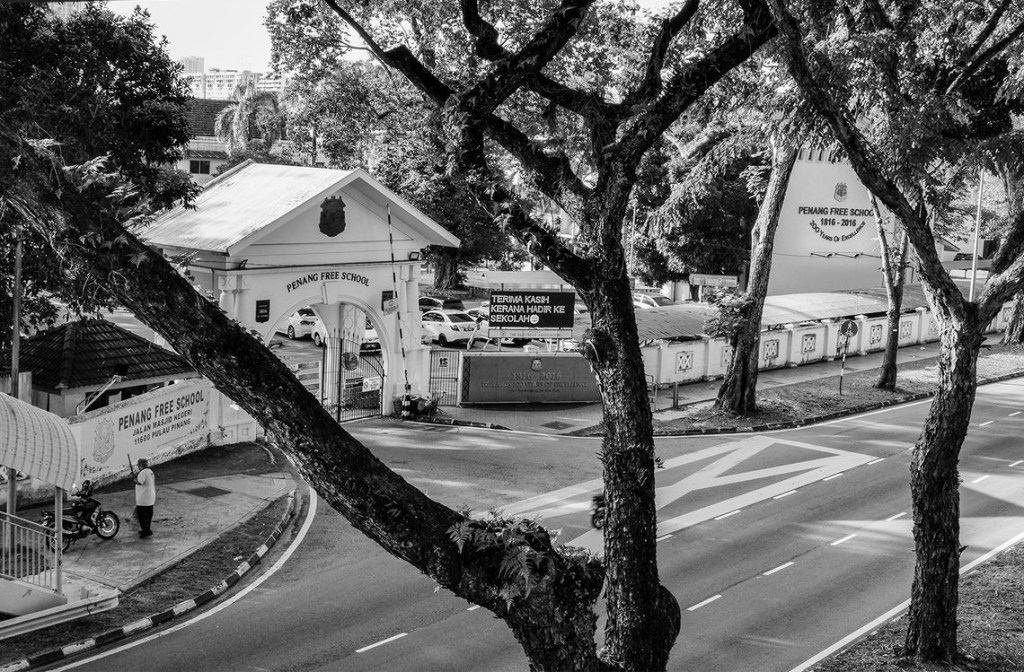
Southeast Asia’s oldest English-medium school – Penang Free School (PFS) – on Penang island, was founded in 1816.
The many luminaries who have graced its halls include Malaysian prime ministers, chief ministers, captains of industry, media titans, musicians and those in the creative and performing arts, legal eagles, religious and grassroots leaders and the list goes on.
Image courtesy of Lim Siang Jin
Over the years, many sons of PFS have given back to their alma mater in various ways.
Self-taught artist Lim Siang Jin, is one such son, whose association with PFS has ranged on various platforms.
Image courtesy of Lim Siang Jin
Until recently, the Kuala Lumpur-based Siang Jin, has been only showing his works to family and friends.
He returns to his hometown Penang this week to pay tribute to his former school.
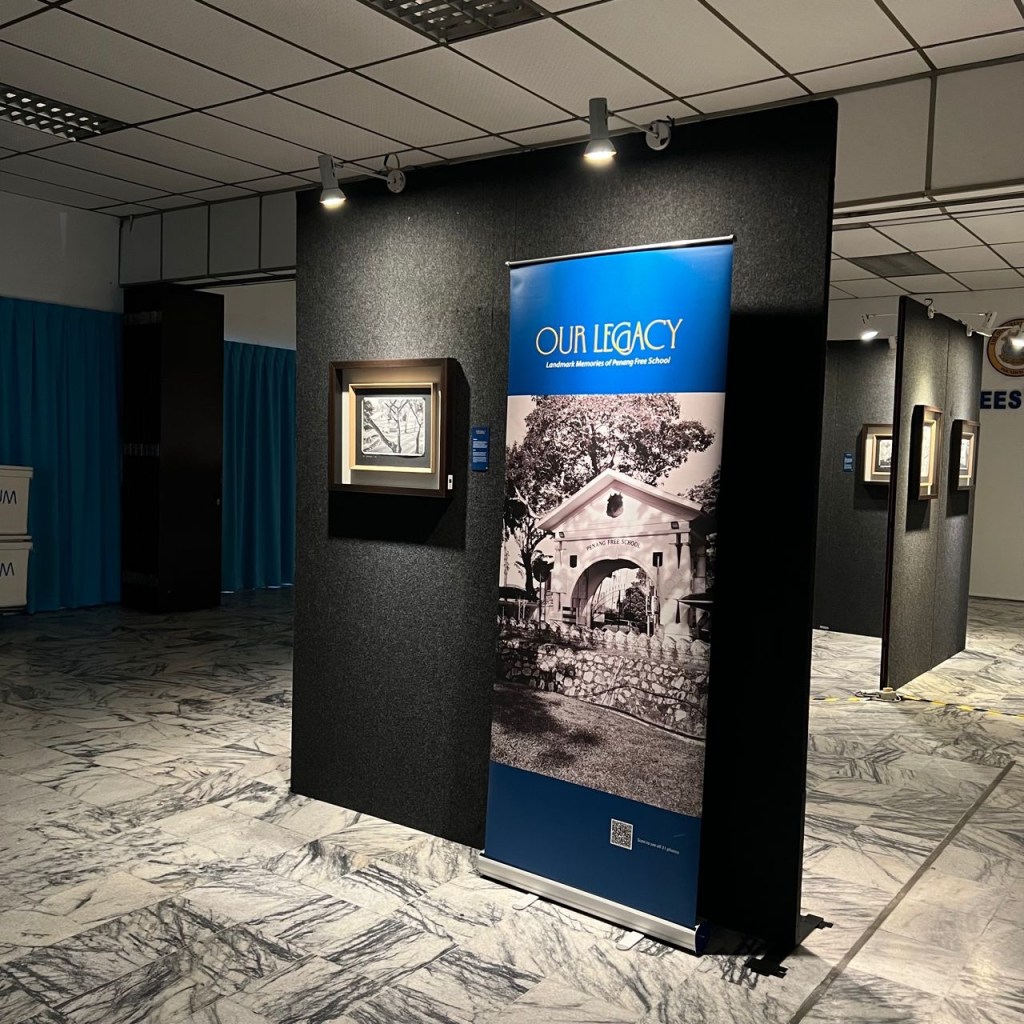
His latest solo: “Our Legacy: Landmark Memories of Penang Free School”, starts today till Oct 3, at The Old Frees’ Association in conjunction with the school’s centenary celebrations.
The exhibition consists of 31 black-and-white prints, each with a write-up by the artist.
Image courtesy of Lim Siang Jin
Siang Jin spent some three decades deeply involved in work, mainly in publishing, communications, branding and marketing.
He was, for example, a founder director of The Edge. He went on to head the media business of Nexnews Bhd that owned the business weekly and theSun.
His website says that in all these endeavours, he continued to take an active interest in the “backroom”, in the production and creative processes of the business.
“Like his art, his work, from publishing to management, is girded by the ideas of Quality, Timing and Aufhebung (the idea that every new development is an inextricable combination of the old and new).”
Siang Jin held his first solo exhibition in Kuala Lumpur in October 2022 where he exhibited some 70 pieces; all these were created during the Covid years (2020-2022).
While his favourite artists, and therefore his main influences, are mainly Western-modern (notably Picasso, Dali, Van Gogh, Matisse, Miro, Klee and Kandinsky), he continues to innovate.
This is especially apparent in the digital-analog creative space where he combines his experience in painting, photography and media production.
Image courtesy of Lim Siang Jin
(“Our Legacy: Landmark Memories of Penang Free School”, will be showcased from 10am-5pm at The Old Frees’ Association, 41 Jalan Sultan Ahmad Shah, 10050 George Town, Penang)
And the gifting continues …
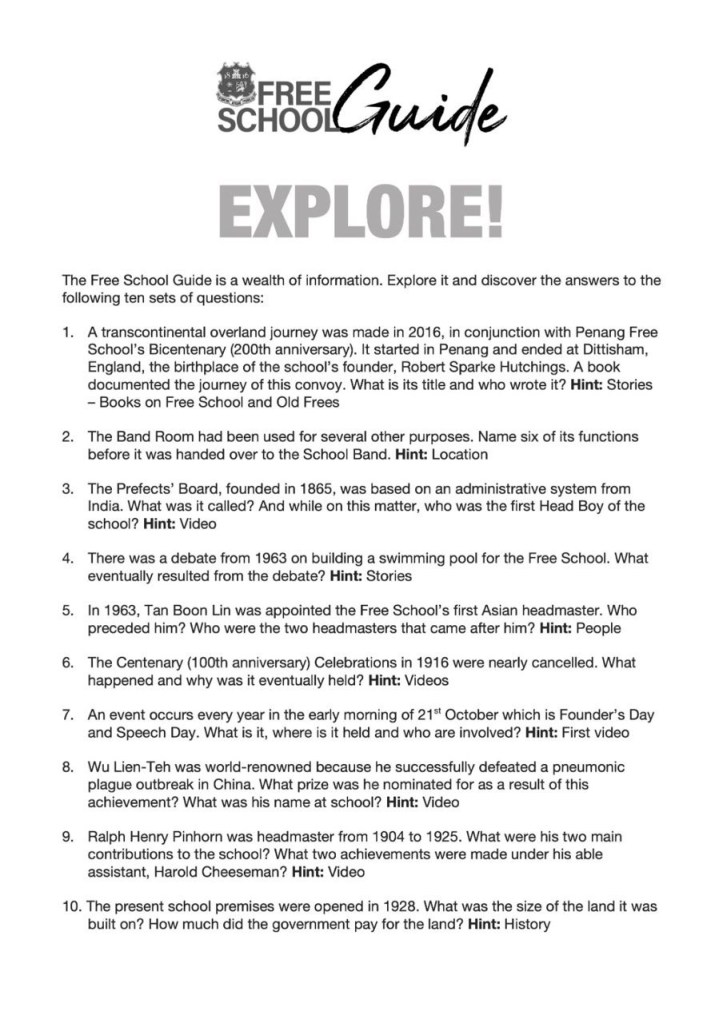
The interactive Free School Guide is available in PDF form. Just click on the subheadings to access the system, and forward all these to people who may be interested in Penang Free School. The 10 sets of “Explore!” questions are to draw them to different parts of the Guide.
(Another gift to his alma mater by Lim Siang Jin and schoolmate SS Quah)
I had my second solo, “Our Legacy: Landmark Memories of Penang Free School”, last September at The Old Frees’ Association in Penang in conjunction with the OFA’s Centenary. I am pleased to inform that I will have it in Kuala Lumpur too. The following are the details:
Date: March 1-31, 2024 Venue: Jin’s Art Gallery, Unit A-3-17, Centrio Pantai Hillpark, 1 Jalan Pantai Murni, 59200 Kuala Lumpur Opening hours: Weekends 10am to 5pm. Weekdays by appointment (please call 019 2219680)
The meals may have been way below their past award-winning and ‘atas’ levels, and much has already been said about it in past weeks.
While the airline sorts out its catering dramas, let’s continue to focus and support our national flag carrier – Malaysia Airlines – for its outstanding crew, new planes and all things that remain amazing about Malaysian Hospitality (MH).
Thank you MH1148 for bringing us home safely and on-time today. If there were any food issues to a destination like Penang (which we did not experience), most residents were more focussed on the nasi kandar and char kuay teow awaiting them on this isle of foodies.
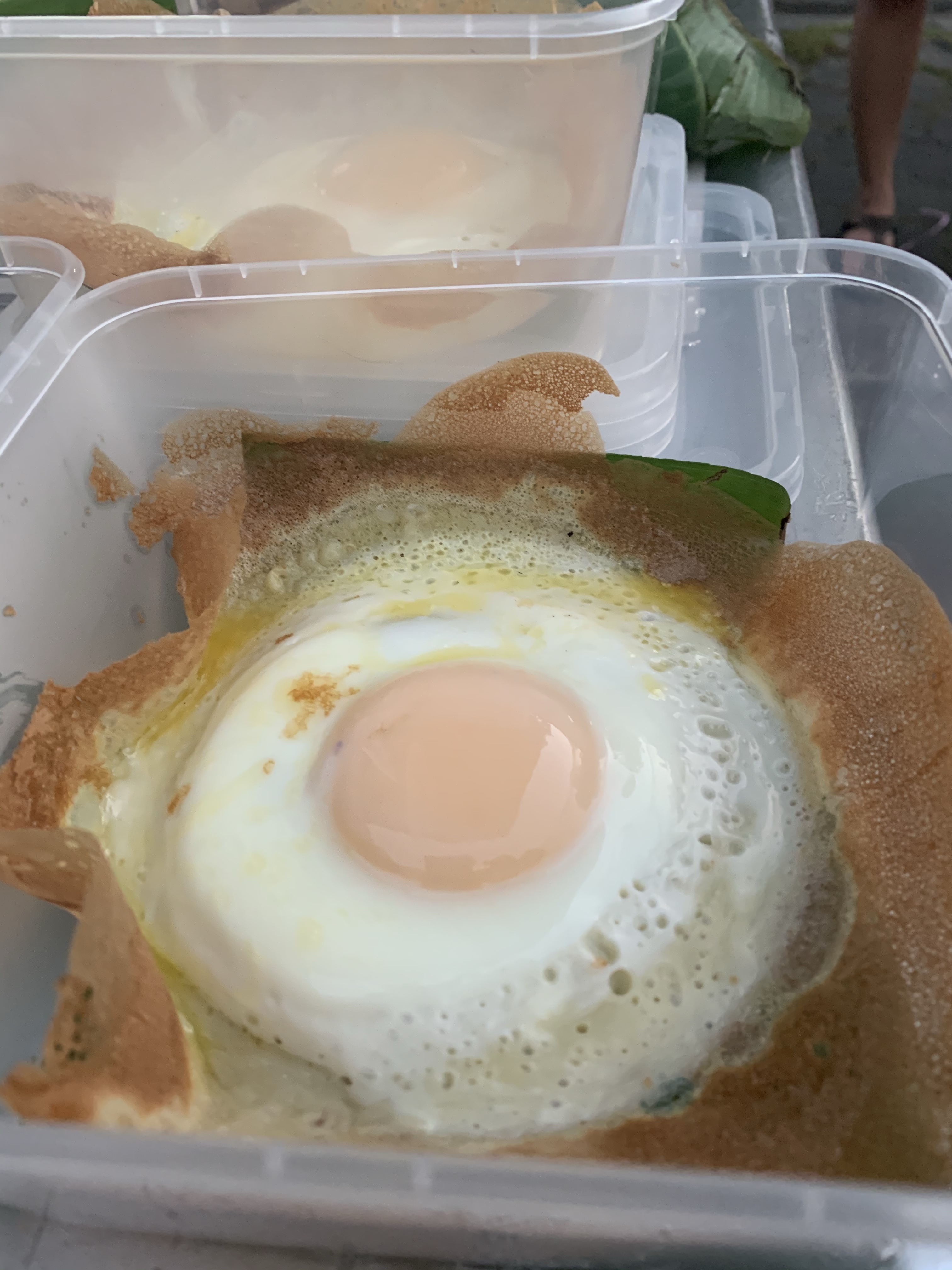
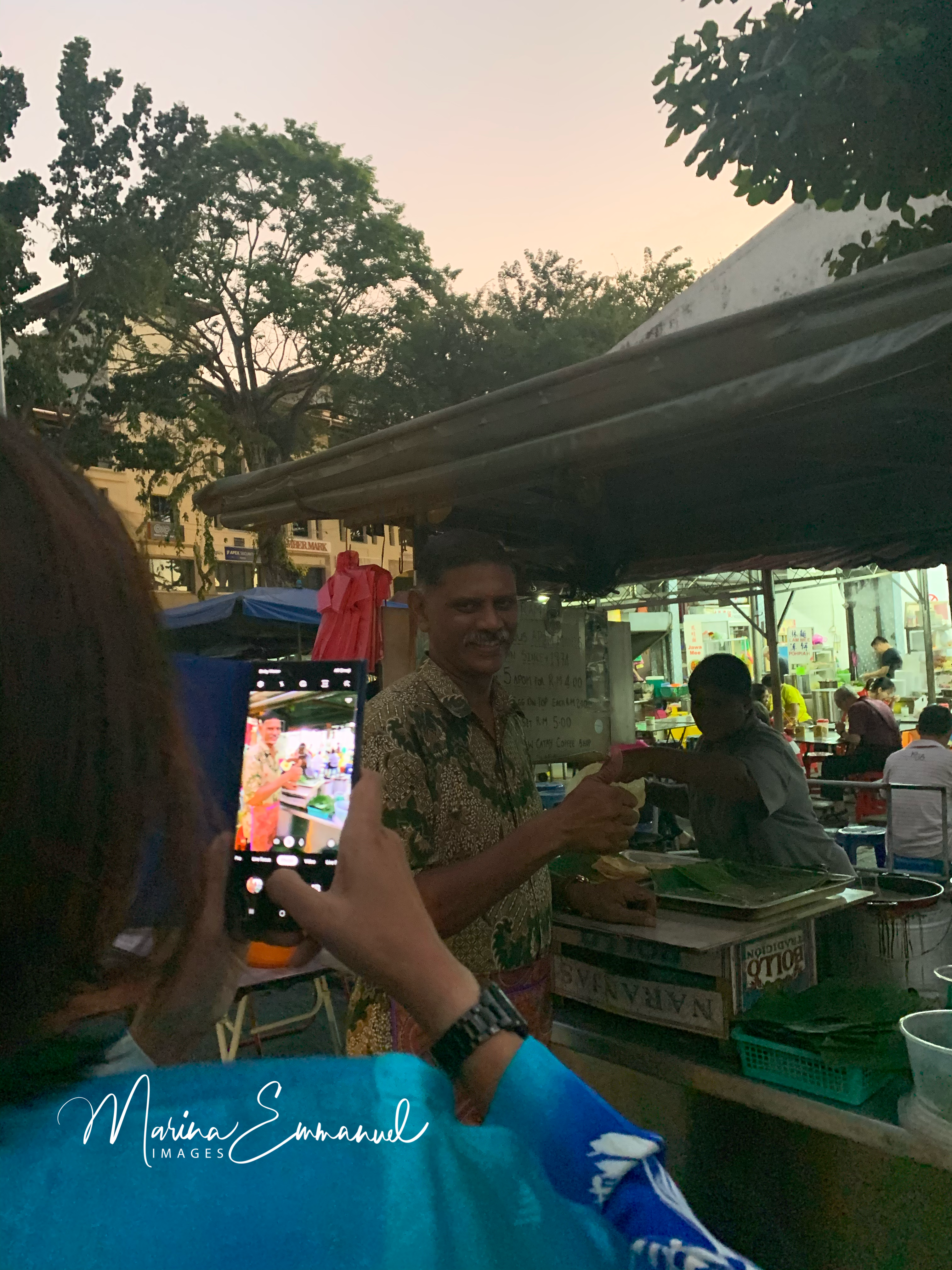
They are usually up at the crack of dawn to prepare the batter of rice flour, eggs and sugar for their ‘apom manis’, which is known to locals as apam, apom lenggang and local crepes or pancakes.
Ravi (above) and his wife Devi (below) greet all customers with warm smiles and have no problems with remembering orders or the sequence they are placed.
Bone and I had a lovely time today watching them deftly prepare our special order and place them expertly in plastic containers with their signature banana leaf for styling purposes.
The humble push cart located outside the New Cathay coffee shop in Pulau Tikus, George Town is frequented by locals and tourists from 7.30am till around 11am from Mondays till Saturdays. Takeaways have and continue to be enjoyed by local and foreign royalty, and other dignitaries.
A pack of 5 apom manis is priced at RM4 and no accompaniments are needed as they melt in your mouth. A “premium” or more “atas” version is also available with an egg on top.
Thank you Devi and Ravi for opening earlier than your usual operating hours today, just so that our special visitors to Penang could enjoy your delicious apom manis for breakfast🙏🏼

































 postcodegeorgetown