A photo of the Assumption Church taken on a cloudy day . Transformed into an image on canvas with digitally-generated cotton representing the clouds based on actual photographs (courtesy image: Leonard Selva Gurunathan)
Nestled within the UNESCO World Heritage core zone of George Town, Penang, the Church of the Assumption stands as a testament to the island’s rich history and cultural tapestry.
Established in 1787, this historic Roman Catholic church has long been a spiritual and community cornerstone, seamlessly blending tradition with modernity.
Among its treasured heritage is its magnificent pipe organ, fondly known as ‘The Old Lady’ – a majestic instrument that has echoed through generations, accompanying countless masses, religious ceremonies, and musical celebrations, and holds the distinction of being Malaysia’s oldest pipe organ.
Recently, a passionate pipe organist and music enthusiast – Leonard Selva Gurunathan – embarked on an innovative project to trace and showcase the church’s musical roots.
Leveraging the power of artificial intelligence (AI) and a suite of cutting-edge tech tools with good old-fashioned research, he has crafted a compelling video narrative that highlights the journey of the pipe organ and its profound role in the life of the church.
The project began with meticulous research into the church’s history, archives, and the evolution of its musical traditions.
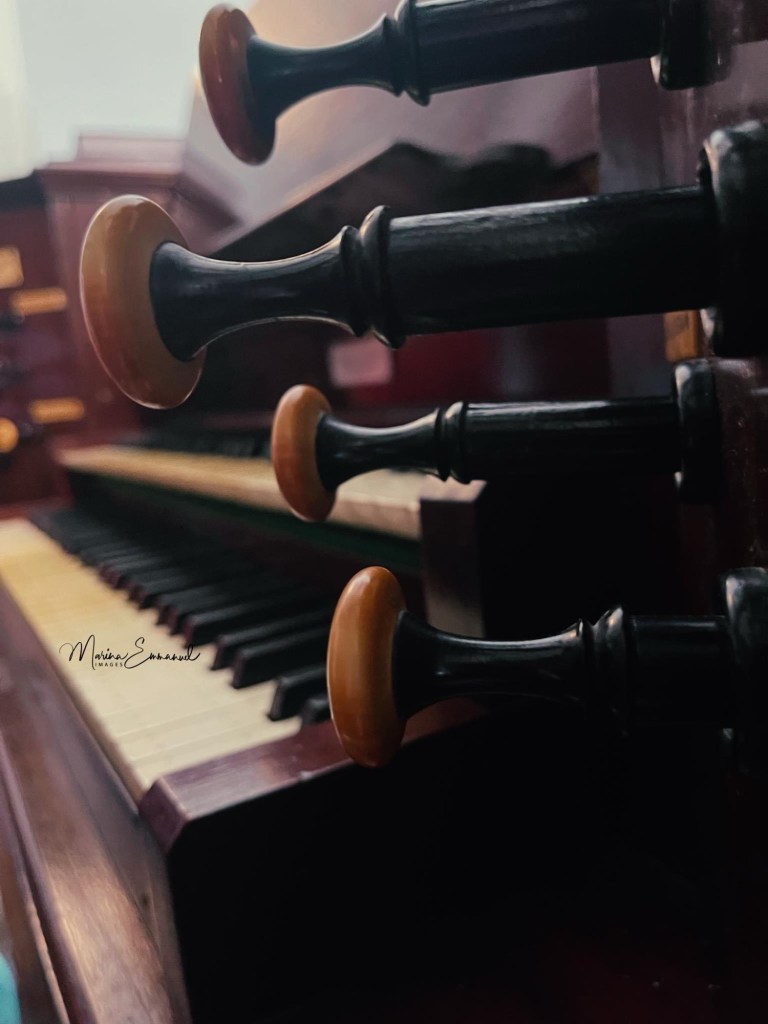
A digital image of the Assumption pipe organ transformed into a diorama setting by Leonard Selva Gurunathan
“ The visual part of the video was done with the use of AI, “said Leonard, “while the rest of it was based on old-school research methods which included going through newspaper archives as I typed the information I needed into the prompts,” he added.
The audio component of the video is based on a live recording put together by Leonard.
“I curated the story,” he notes, “based on the duration of the music.”
To visualize the church’s and pipe organ’s rich history, Leonard employed AI-powered video editing and animation software. These tools transformed static images and archival footage into dynamic visuals, illustrating the organ’s physical changes, restorations, and its integration into the church’s liturgical life over the years.
The entire production has served as a testament to how technology can serve as a bridge—connecting heritage, faith, and innovation.
The resulting video not only celebrates the Church of the Assumption’s storied past, but also highlights the enduring significance of its pipe organ as an instrument of worship and cultural identity.
It underscores how the organ has witnessed generations of worshippers and has become an integral part of the church’s spiritual and community life.
This project exemplifies how modern tools can be harnessed to preserve, interpret, and share heritage in compelling ways. It also emphasizes the importance of safeguarding such cultural treasures within UNESCO’s protected zones, ensuring that future generations continue to appreciate the rich tapestry of history, faith, and music.
As the Church of the Assumption continues to serve its community within the vibrant streets of George Town, its story—enhanced by AI, technology and old-school research methods – reminds us that tradition and innovation can go hand in hand.
By blending historical preservation with modern storytelling, Leonard’s creative endeavour invites us all to reflect on the enduring power of music, faith, and heritage in shaping our collective identity.
The Jubilee Concert at the Church of the Assumption (courtesy image – Boon Tiong)
Two Saturdays ago, the Church of the Assumption in Penang became a living instrument for a concert that stitched tradition, youth, and reverent sound into one unforgettable evening.
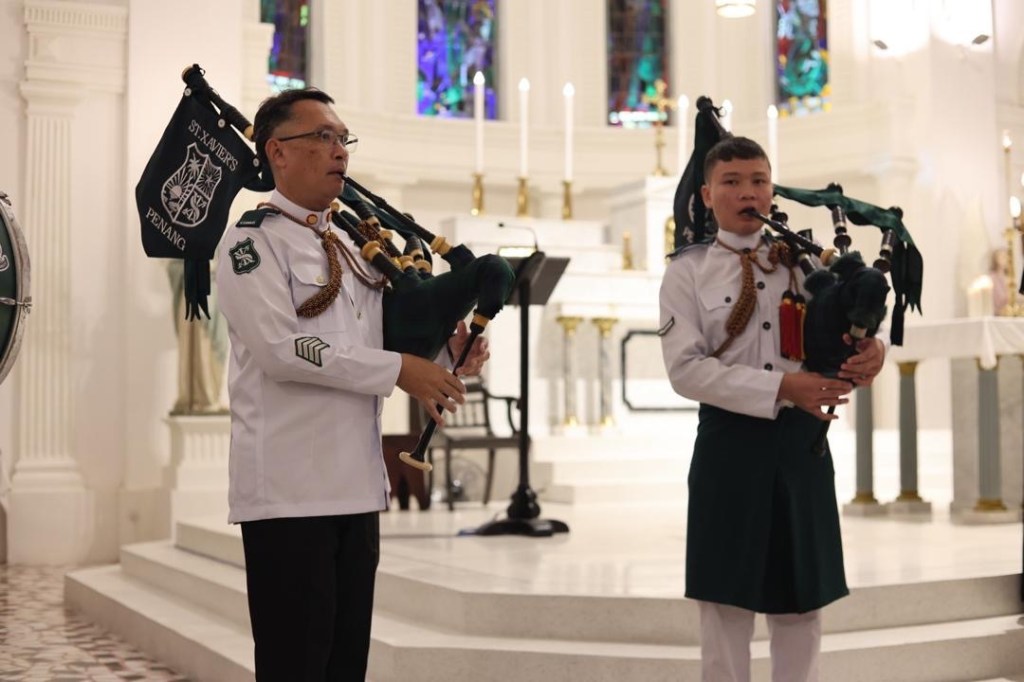
The church was welcoming, with the soft rustle of pews, as Saint Xavier’s Institution Corps of Pipes and Drums took the “stage”, their drums beating in confident, marching heartbeats and the pipes lifting like clear, silver voices. The opening procession felt less like a performance and more like a rite of passage—bold, bright, and glinting with pride.
The choir followed with a range soars-high and whispers-soft, a bright thread weaving through the nave. Their blend was lush yet precise, each phrase carried by a spine of harmony that filled every corner of the church. It’s a rare gift to hear a room feel both intimate and exultant at once, and that night, the choir’s voices did that subtle magic, lifting without ever shouting. Choir master Claude Richards’ baton moved with equal parts discipline and warmth, drawing clean lines and then dissolving them into shimmering colour, as if pulling rainbows through the arched ceiling.
Assumption Church Choir with His Eminence Sebastian Cardinal Francis, Bishop of Penang (courtesy image – Boon Tiong)
Between addresses and pieces, the “Old Lady”—the heritage church’s pipe organ—held court with patient majesty.
Resident organist Leonard Selva Gurunathan and neighbouring St George’s Church pipe organist, Matthew Arwinraj, took turns to coax “conversations” which began with a whispered echo and blossomed into grand, cathedral-scale statements.
Pedals clicked like distant thunder, and the tonal palette—great, flute, principal—poured through the nave with a timber that felt both ancient and newly-minted for the moment. If the pipes are the church’s memory, the Old Lady spoke it aloud: a history lesson told in luminous chords, each note lingering in the vaults long after it was spoken.
The ripple of the Corps of Pipes and Drums kept the energy alive even as the choir’s velvet harmonies settled the room into hushes of awe. When the final chord faded, the silence stretched, a shared breath between performers and listeners, before breaking into sustained applause that seemed to say, “Thank you for listening as deeply as you were listened to.”
Leaving the church, the night felt lighter, as if the walls themselves still hummed with the collaboration of youth, faith, and music. It was more than a concert; it was a celebration of community, tradition, and sound that lingers in the heart long after the bells have faded.
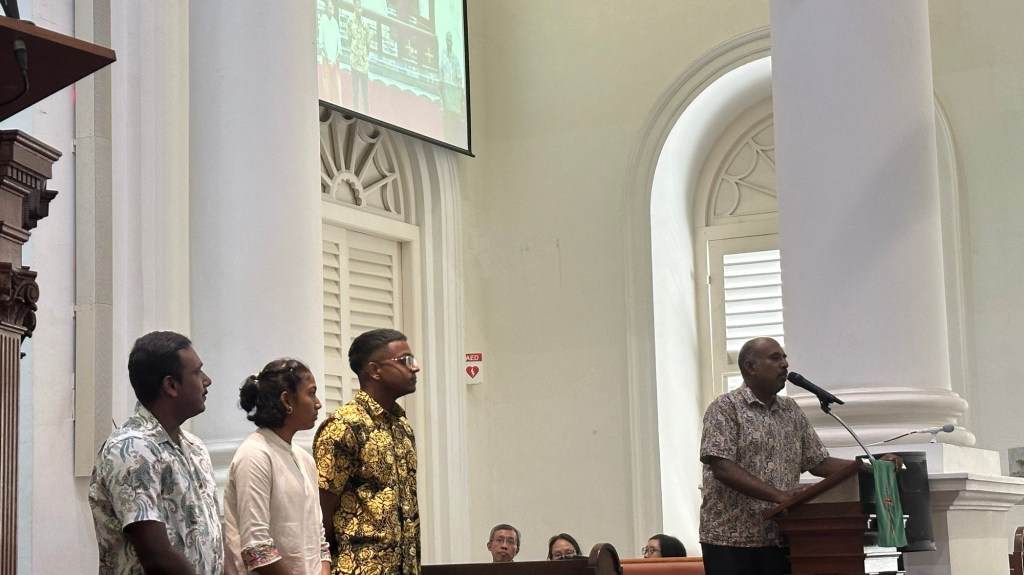
Choir master Claude Richards (extreme right, in white shirt) with his members and other concert performers (courtesy image – Boon Tiong)
My first “sighting” of this lovely and funny soul was at The Star Penang newsroom in 1993, when I joined as a reporter and she was the paper’s freelance writer/stringer.
Once she got behind the computer she would remain focussed and quiet as she went about putting together her famous food reviews.
The sub-editors usually found themselves needing to consult the dictionary when clearing her copies (Aiyo Fay, why are you using such big words, you think our readers can understand, meh? was usually conveyed to Fay by Anna Cheah our then chief sub-editor) Fay would simply smile and give some funny retort and everyone would laugh.
Her love for food was legendary. Some of us would join her for quick hawker meals close to the office when she stepped in to meet her deadlines. As most people know, this foodie was just as adept in appreciating fine food and made no bones when any dish did not meet her exacting standards.
When she moved on to other interests, especially in publishing, I used to pick up her nifty card sets with watercolour images of all things Malaysiana and even tried her ‘Miss Khoo’s Asian Deli’ gourmet products at the time, as I heard they had found their way to the shelves of Harvey Nichols in the United Kingdom.
The writer, TV and radio host, publisher, lover of all things nautical and much-loved daughter, always had a kind word for everyone and we missed her laughter and teasing when she left The Star to pursue other projects and adventures.
It was shocking and painful to many of us to hear that Fay, who was then 48, had left us after a brief illness in April, 2017.
Bettina Chua Abdullah and I had a mutual friend in Fay and our stories and friendship with this fun-loving soul are different and yet, the same. Fay shared different friendships with different people and made her mark which can never be erased.
Which now brings us to the third edition of the Fay Khoo Award for Food and Drink Writing which Bettina organised and has been directing to honour Fay’s legacy.
The call for entries has been made and details found below. The 2019 winners will be announced at this year’s George Town Literary Festival which takes place in Penang from Nov 21-24 (please mark your calendars)
Thank you Bettina, for your dedication in keeping Fay’s memory and our friendships alive!
(In addition to written narrative entries for the award, comics and graphic stories are also open to authors and illustrators wishing to submit illustrated narratives)
CALL FOR ENTRIES 2019
The aim of The Fay Khoo Award for Food+Drink Writing is to recognise new and talented voices, and to encourage and develop excellence in food and drink narratives. We believe that there is a space and a need for well-researched and impactful food journalism, because it is through such writing that we can shine a light on people, culture, health, economics and the environment of culinary delight.
This year we hope to present awards to the three best entries, regardless of category. Please read the conditions of entry and submission guidelines carefully, as these have changed from previous years.
The CONDITIONS OF ENTRY are as follows:
• All writing must fall into the categories of personal narrative, reportage or creative non-fiction.
• Entries should not exceed 2000 words.
• Entries must be submitted in English, and must be the sole work of the entrant.
• Entries must never have been published, self-published, broadcast or uploaded on any
website, blog or online forum.
• Anyone over the age of 16 years at the time of the closing date, who is a citizen or resident
of ASEAN countries, may submit up to three (3) entries.
• A fee of RM 20 per submission will be levied to cover administrative costs.
Processing of fees is made by Hikayat Lebuh Pantai, which manages The Fay Khoo Award, upon submission of entry/entries.
Bank details are as follows:
Maybank | Hikayat Lebuh Pantai Sdn Bhd | 557018565194
Please reference your payment with FKA and your WhatsApp number: eg FKA 012-345-6789
If you do not have a mobile phone, please use a landline number.
SUBMISSION GUIDELINES
• Entries must be saved in Microsoft Word format, and emailed to
thefaykhooaward@hikayat.asia
• Entries need to be double-spaced and the word-count noted at top of the first page.
• Entries must include a WhatsApp or landline number, so that you can be sent a confirmation
that your entry has been received, and we can link submission fees to your entry.
• To protect the integrity of the judging process, entries must not include your name or email address. We will contact you via the WhatsApp or landline number you have provided, for your name and other necessary information.
• Amendments or revised versions will not be accepted.
• Entries will be accepted from July 15, 2019 and must be received by September 15, 2019.
• A fee of RM 20 per submission will be levied to cover administrative costs.
• Entrants who have not turned 18 by November 1, 2019 must provide a parent/legal guardian’s name and contact details.
NOTES ON JUDGING
• There will be three (3) judges for the Fay Khoo Award. The judges’ decision is final.
• The judges will not comment on individual entries.
• The Fay Khoo Award reserves the right to change the panel of judges without notice.
• A Longlist of up to 15 entries will be announced by October 10, 2019, and writers notified by WhatsApp and email.
• A Shortlist of 6 entries will be announced by October 28, 2019, and writers notified by
WhatsApp and email.
PRIZE-GIVING
• The winning entries will be announced at the George Town Literary Festival between
November 21-24, 2019. Accommodation will be provided for the day of the prize-giving.
INTELLECTUAL PROPERTY
• Worldwide copyright of each entry remains with the author, but by virtue of submitting an entry, participants are assigning unrestricted right to publish the winning entry, shortlisted entries and long-listed entries in any format. This right is granted to the managers of The Fay Khoo Award, Hikayat Lebuh Pantai Sdn Bhd and its associates in perpetuity, upon submission of the entry for consideration.
• The Fay Khoo Award will retain fully all income generated by publication of the winning entries, shortlisted entries and long-listed entries, while the author will retain all income generated by their publication separate to this.
• In cases where the author of a winning, shortlisted or longlisted entry independently publishes said submission, the author will mention that the piece was a winner or shortlisted or longlisted entry in The Fay Khoo Award for Food+Drink Writing.
PRIZES:
• Each of the three winners receives a cash award of MYR1500, and a book voucher for MYR500
• Shortlisted entries may also receive other supplementary prizes, at the discretion of the organisers.
AMENDMENTS:
• The organisers of the Fay Khoo Award reserve the right to amend these conditions of entry
if deemed necessary. Any changes will be posted on the award’s Facebook page.
• For further information, please email thefaykhooaward@hikayat.asia
(Images courtesy from the FKAward Facebook and Fay’s)
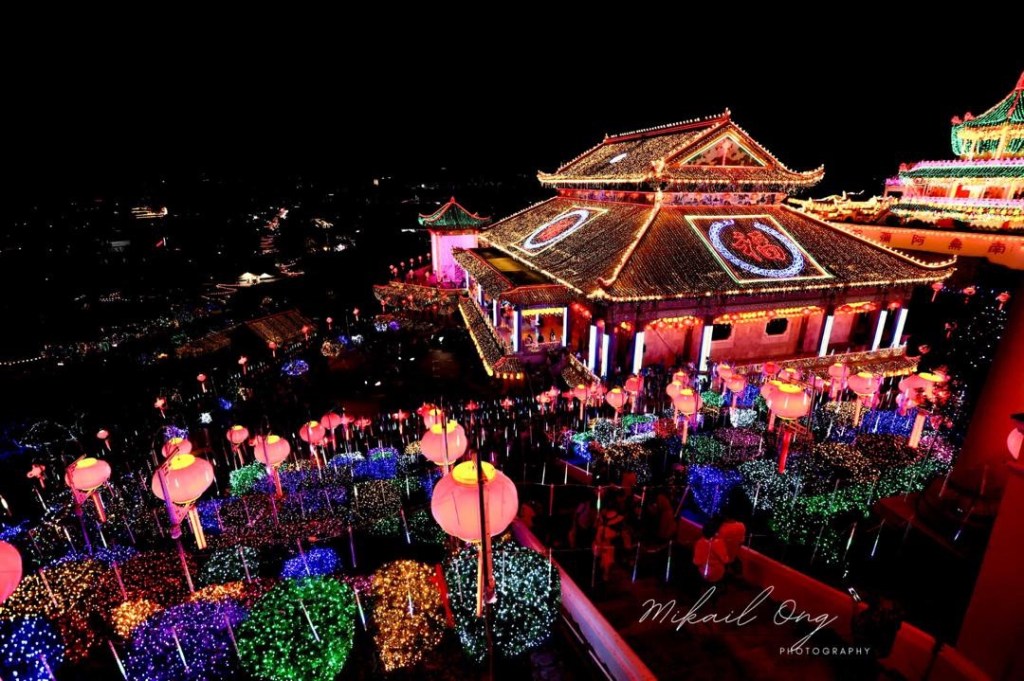
As the sun dips below the horizon and the vibrant hues of twilight envelop Penang, the Kek Lok Si Temple transforms into a mesmerizing spectacle, particularly on the eve of the Lunar New Year. This iconic Buddhist site, nestled atop a hill, becomes a beacon of hope and gratitude, drawing not only our Buddhist sisters and brothers but also Malaysians from all walks of life and visitors from around the globe.
The atmosphere is electric with anticipation as families and friends ascend the temple grounds, each step a journey of devotion—giving thanks for the past year and seeking blessings for the one to come. The air is filled with the soft sounds of prayers, the rustle of red envelopes, and the gentle whispers of wishes that float like the incense smoke rising to the heavens.
Family and friends make their way to the grounds of the Kek Lok Si Temple
What makes this gathering even more heartwarming is the sight of diverse communities coming together.
Malaysians (and tourists) of various races and faiths joined in unison, united by a shared appreciation for the stunning beauty of the temple, which glowed with thousands of LED lights. The sight was nothing short of breathtaking—a harmonious blend of spirituality and artistry that captivates the senses and inspires the soul.
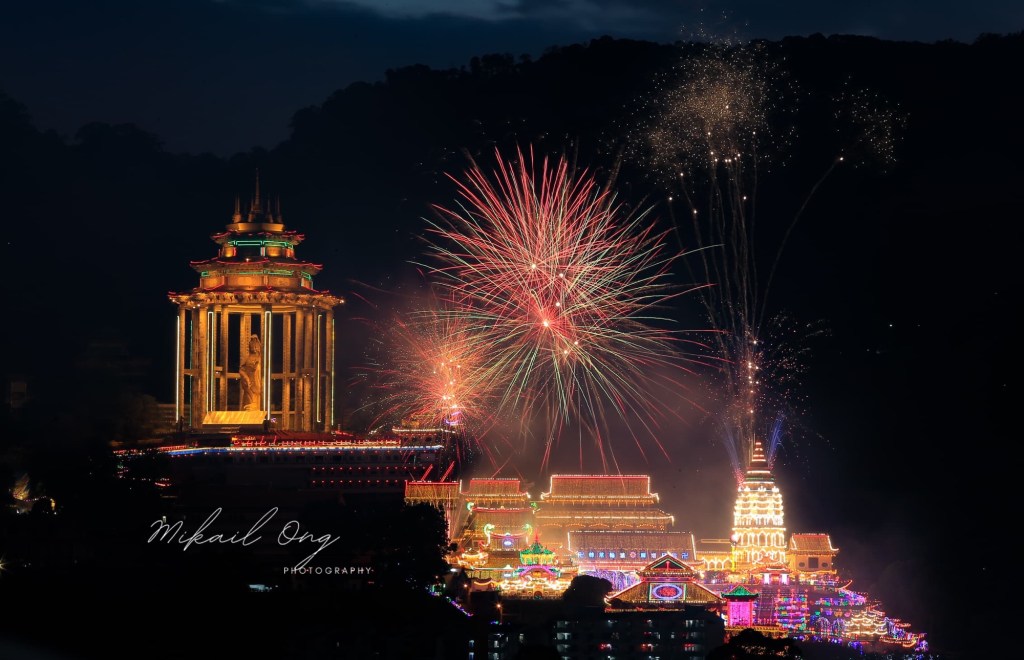
Among the highlights of the Kek Lok Si Temple at Air Itam on Penang island, are its intricate pagodas and the towering statue of the Goddess Kuan Yin, which stands as a reminder of compassion, unity, and love.
The Goddess Kuan Yin smiles down on all visitors against the backdrop of a fireworks display
As visitors pause to admire the architectural wonders and intricate details, they are also reminded of the values that bind us all together, transcending differences in belief and background. It’s a beautiful testament to the spirit of Malaysia—a melting pot of cultures, where respect and appreciation for one another flourish.
Lensman Mikail Ong had the unique opportunity to capture this enchanting scene on assignment, and he has generously shared his stunning photographs with us.
His lens reveals the magic of the moment—each shot telling a story of joy, reverence, and the shared human experience. Aud and I, as his sisters in the media, can only dream of capturing such beauty; Mikail’s work encapsulates the essence of what makes Kek Lok Si Temple on Lunar New Year’s Eve a sight to behold.
A Lunar New Year icon … the Kek Lok Si Temple
As you scroll through the images in this post, let each photograph transport you to that hilltop sanctuary, where the glow of lights and the warmth of community create an unforgettable tapestry of life and celebration.
Whether you are a seasoned photographer or simply someone who enjoys the beauty of the world, visiting Kek Lok Si Temple during this festive season is truly a treat for shutterbugs and a heartwarming reminder of the bonds that tie us all together.
May the blessings of the new year fill your hearts with joy, compassion, and unity, just as they do at the Kek Lok Si Temple. Happy Lunar New Year!
Nestled along the picturesque coastline of Penang, the Eastern and Oriental Hotel (E&O) is a treasure trove of history and charm. As you wander through its hallowed halls, you’ll uncover a wealth of unique features that pay homage to Penang & Malaysia’s rich heritage.
A courtesy map in every room is a good reference and here are some highlights:
The E & O Map
E & O Gallery
One of the highlights of your visit should undoubtedly be the E & O Gallery, where the exquisite handsewn wedding dress of Patsy Addington is proudly displayed. This stunning piece is not just a garment; it’s a testament to love and craftsmanship that resonates with the stories held within the hotel’s walls.
Waygood-Otis Lift
Step into the historic Waygood-Otis lift, a marvel of engineering from the 1920s. This charming lift whisks you between floors while evoking a sense of nostalgia, reminding you of the elegance of a bygone era.
19th Century Cannon
Don’t miss the iconic 19th-century cannon that stands sentinel, pointing out towards the Andaman Sea. This relic of the past serves as a reminder of the hotel’s storied history and the strategic importance of Penang in maritime trade.
Echo Dome
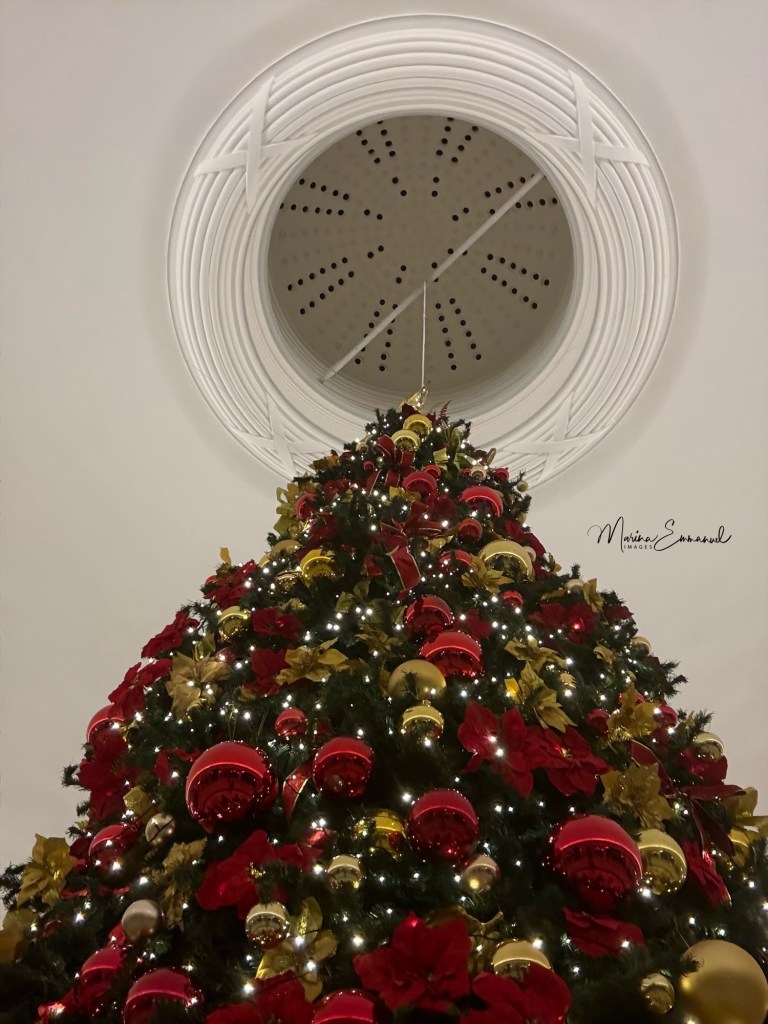
Finally, immerse yourself in the enchanting acoustics of the Echo Dome, an architectural wonder that virtually broadcasts sound throughout the lobby. Gather with friends and family, (especially during this 🎄holiday season 🎄) and experience the beautiful interplay of sound and space that defines this unique feature.
The hotel’s iconic Echo Dome
At the E & O Hotel, every corner whispers tales of grandeur and history, inviting you to create your own memories in this timeless setting. Whether you’re enjoying a leisurely afternoon tea or exploring this heritage hotel’s rich past, your stay promises to be an unforgettable experience.
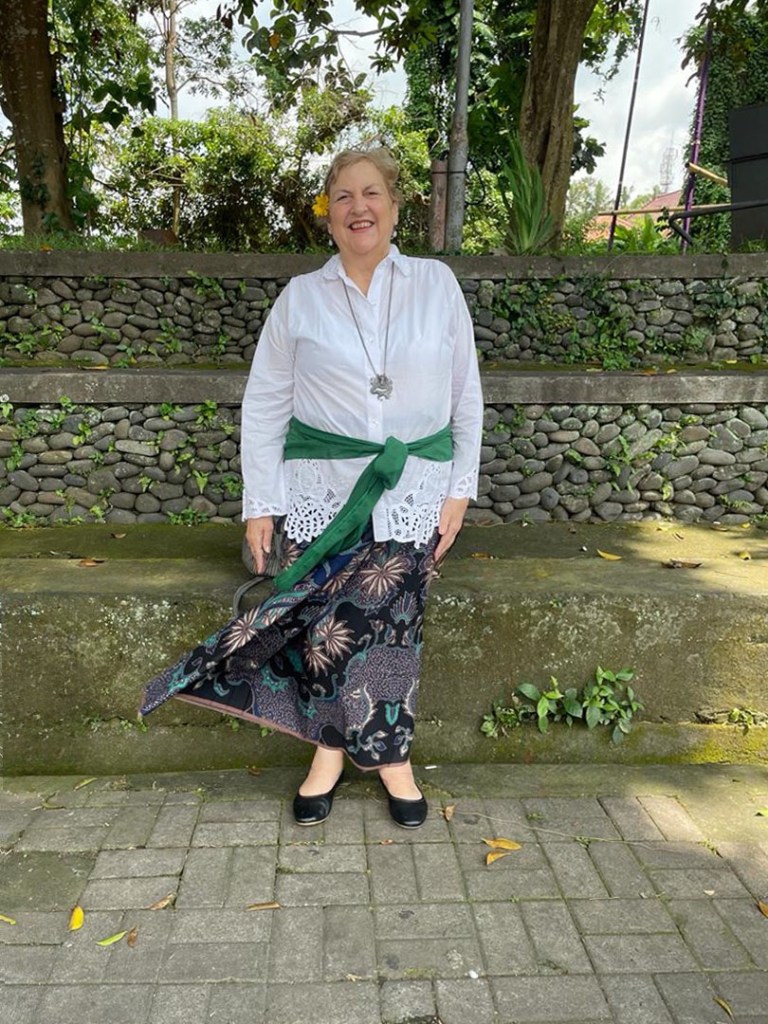
Kim, a vibrant and colourful soul whose love for fabric and textiles was matched by her passion for travel and devotion to music, has left us after an illness.
Kim at one of her favourite travel destinations (Bali) this year (photo by Tess tweaked by Boon Tiong)
Her creative spirit shone brightly through her work with textiles which saw the production of a book.
The book authored by Kim
An avid traveler, Kim, embarked on countless adventures, exploring new cultures and gathering inspiration for her work, as she set up homes with her late husband Michael Saunders, in various Asian cities. She cherished every journey, finding joy in discovering new places, meeting new friends, and experiencing the beauty of the world.
Her devotion and love for dogs is legendary and she will be remembered for always being the first to lend a hand and donation to those in need.
Kim’s love for music, particularly choral singing, enriched her life and the lives of those around her.
Whether performing in local choirs or sharing her love of music for God in church, her voice resonated always with passion and joy. She found solace and connection through song and hymns, and her spirit will undoubtedly echo in the hearts of those who sang alongside her.
Kim sang in the Church of the Immaculate Conception, Penang’s choir
Now, Kim is reunited with her beloved Michael, and together they continue their journey in the beyond. May their love inspire us to embrace our passions and cherish every moment.
Rest in peace, Kim. Your legacy of love, service and inspiration will be etched in all our hearts.
On her 117th birthday on Sept 3, 2016, Google honoured Malaysian freedom fighter Sybil Medan Kathigasu with a dedicated doodle.
A doodle by Google to honour Sybil Medan Kathigasu
She is shown in her nurse’s uniform outside her former residence in Papan, Perak.
The patterned ribbon of the George Medal surrounds the doodle, a tribute to Kathigasu’s courageous contributions to the anti-occupation movement.
“On the 117th anniversary of Kathigasu’s birth,” Google said, “we remember and celebrate her tireless dedication to freedom.
“Thank you, Kathigasu, for your courage and the powerful legacy you’ve left behind.”
While we know that Sybil Kathigasu’s “war story” speaks of how her acts of courage during World War II had devastating consequences, not much is said of what her family had gone through.
History tells us she was married to Dr Abdon Clement Kathigasu at St John’s Cathedral in Kuala Lumpur and they had three children, a son (William whom they had adopted) and two daughters, Dawn and Olga.
After her parents had been arrested for resistance activities in 1943, Dawn was suspended over a fire and threatened with death unless her mother Sybil, who had already been tortured in vain, gave information about the guerillas.
The six year old, enduring her pain, implored her mother not to talk and was saved only by the intervention of a senior Japanese officer.
She later went to Britain to study medicine and is believed to have married and settled there.
A heart warming memory of Olga is relayed here by Deacon Dr Leslie Petrus.
Rev Deacon Dr Leslie Petrus (image from the Malacca Johore Diocese website)
“I first met Sybil’s eldest daughter Olga in 1971 when she moved into the house next to Matron Irene Stephens,” he recalls.
Stephens, Dr Petrus noted, was the matron-in-charge of women prisoners in Batu Gajah prison under the Japanese Government and Sybil was under her supervision.
“Matron Stephens, our close family friend, had retired from the Prisons Department in the mid- 60’s,” he added.
The deacon recalls Olga as “the lady in black.”
“She always wore a black dress with black shoes and a black veil and carried a black bag.
“She kept to herself and never talked to anyone or even smiled. I did not understand then, her unique character but I do now.”
His up close and personal experience with Olga was in 1972 when Queen Elizabeth, Prince Philip, and Princess Anne were on a royal visit to Malaysia and made a stopover at Penang.
“My mother,” he remembers,” decided to go and invited Matron Stephens and Olga to follow us.
“In a cramped Opel Record car, we were in Penang the whole day, and stood for few hours at Dewan Sri Pinang just to see them at the balcony.
“As we waved our handkerchiefs, she had a Union Jack flag, and wore a hat with the flag on it. I can still remember the first and only smile on her face. I sensed then she was proud of her mother as she carried the picture of her mum with the medal of George V for highest bravery. “
Later, that day, Dr Petruse said, Olga had wanted to see the Royal Brittania and he had to follow her into a small sampan boat, at the fishermen’s jetty, where Olga paid a premium price to a local fisherman for the ride.
“I could see her looking so intently and so connected. Even now, I can still remember how she never took her eyes off the ship, probably feeling grateful that her mother and her father were special people.
“As I recall that one day trip to Penang with her, (I was 13 years old then), I then knew why she always wore black.
“She had lost her father early 1972. With all that she had experienced since her childhood, she had kept the faith.
That day trip to Penang with Olga was described as a “blessing” by Dr Petruse.
“She was in deep pain and sadness. But she never showed it. Her silence each time I saw her spoke volumes of God’s grace and love.”
In her memoir `No Dram of Mercy’, Kathigasu or Mrs K as she was affectionately known to the people of Ipoh and Papan, Perak before and during World War II, tells a story of courage, compassion, defiance and faith.
As she offers a harrowing firsthand account of the Japanese occupation of Malaya during the war, she takes her readers into the chaos of the invasion and how her peaceful life as a nurse, wife, mother and daughter was disrupted.
This was a form of disruption which appeared to transcend just mere inconvenience; it becomes a brutal struggle for survival under oppressive Japanese rule.
As a nurse and a staunch supporter of the Malayan resistance against Japanese occupation, Kathigasu’s life is a powerful narrative of sacrifice, courage, and commitment to humanitarian principles.
The push for her beatification within the Catholic Church highlights her exemplary virtues and profound moral integrity, confirming her legacy as a beacon of hope in times of darkness.
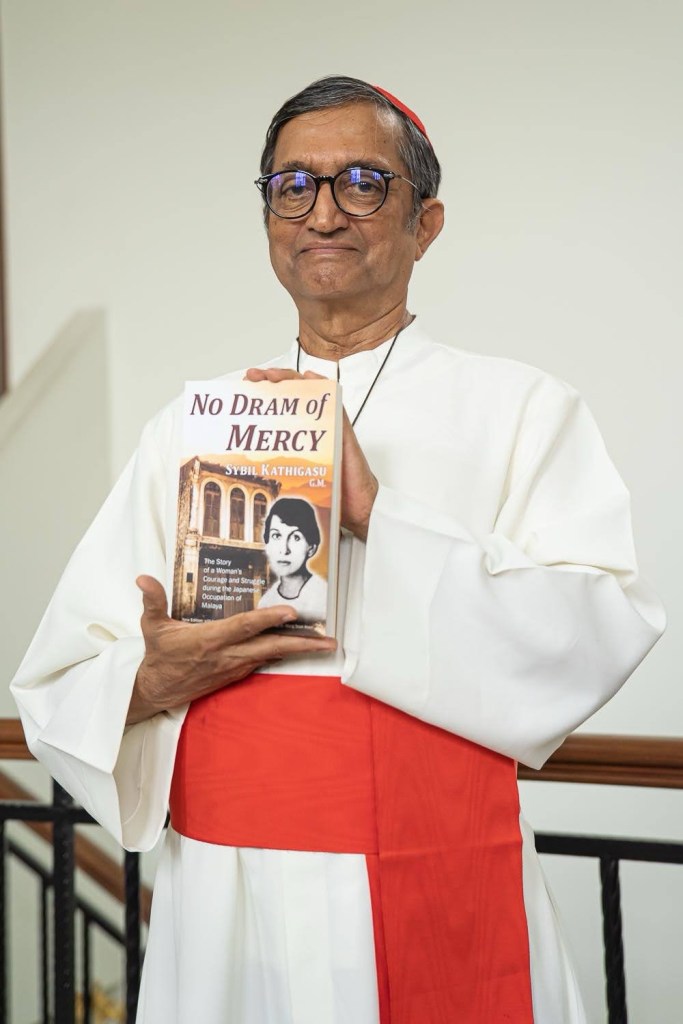
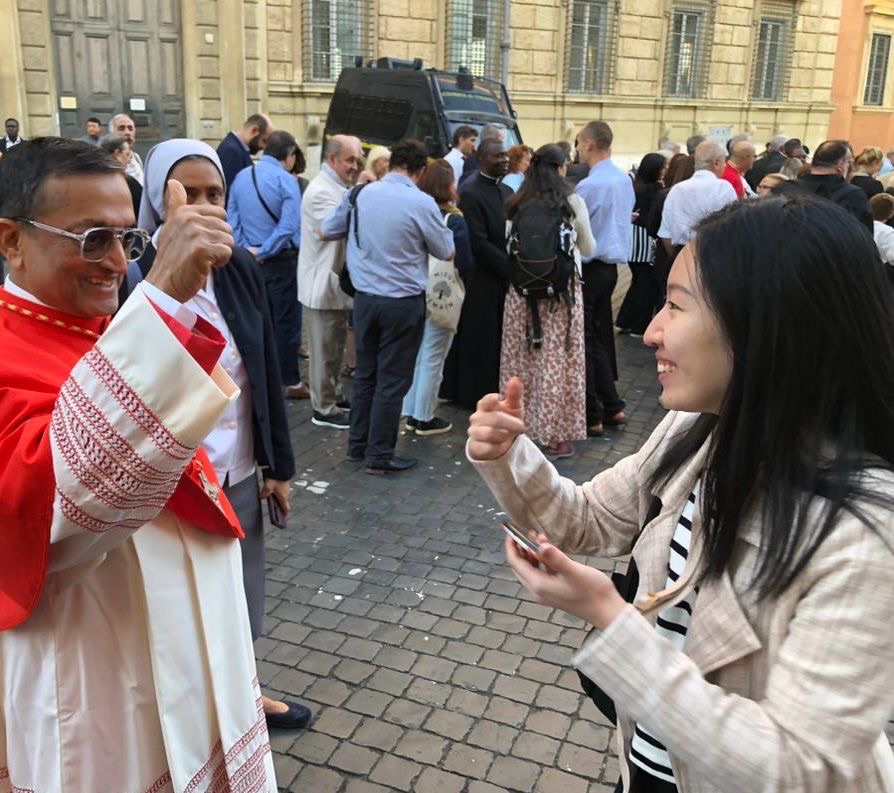
“Her faith in God as a Catholic and a disciple of Christ is the primary orientation the Diocese of Penang is pursuing,” its bishop Cardinal Sebastian Francis said in an interview.
Cardinal Sebastian Francis with Sybil Kathigasu’s memoir ‘No Dram of Mercy’ (picture by Boon Tiong)
“Our focus is on her perseverance and fidelity to her profession as a nurse to the Florence Nightingale Pledge,” he added.
The pledge which is named in honour of the founder of modern nursing – Florence Nightingale – states:
“I solemnly pledge myself before God, and in the presence of this assembly, to pass my life in purity and to practise my profession faithfully.”
Cardinal Sebastian also said that the diocese will focus on Kathigasu’s courage and valour, to undergo persecution and suffering in her career as a nurse, and being honoured with the George Medal for bravery in 1947.
(She is the only Malayan woman ever to be awarded the George Medal. The George Medal (GM), instituted on 24 September 1940 by King George VI, is a decoration of the United Kingdom and Commonwealth, awarded for gallantry, typically by civilians, or in circumstances where military honours are not appropriate.)
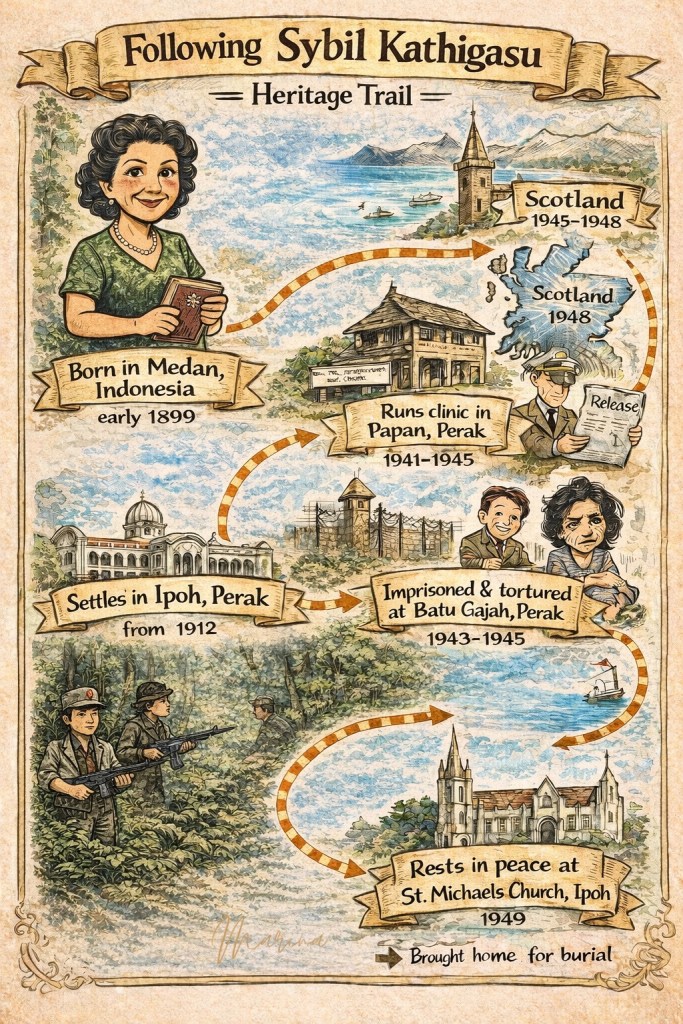
Kathigasu died in 1948 and was buried at the cemetery in the Church of St. Michael in Ipoh, Perak.
Sybil Kathigasu’s final resting place in the grounds of St Michael’s Church, Ipoh (picture by Daniel Roy Santiyagu)
The Cardinal is also appealing to those with any information, photographs or any research on Sybil to forward these to Daniel Roy Santiyagu who is the head for social communication for the Diocese of Penang at: socialcomm@pgdiocese.org
Born in 1910 in Ipoh, Perak, Sybil Kathigasu was a trained nurse who, along with her husband, played a crucial role in providing medical care to resistance fighters during the Japanese occupation of Malaya from 1942 to 1945. Kathigasu’s work with the underground organization, known as the “Malayan People’s Anti-Japanese Army,” exemplified her courage as she operated in tremendous danger, often risking her life and those of her family for the greater good.
During the war, she not only offered essential medical assistance but also acted as a source of intelligence. Her contributions were instrumental in the efforts to undermine the occupying forces. Her actions reflect a selfless devotion to her fellow countrymen and a passionate commitment to justice, making her a symbol of resistance against tyranny.
The Diocese of Penang has officially opened the cause of beatification and canonization for Kathigasu, whom Sebastian said continues to inspire people even 76 years after her death.
“I see this as an opportunity to bring together and reflect on her life for us as people of faith,” said the cardinal.
While she was born in Medan, Indonesia, the story of this daughter of Malaysia unfolds in cities and towns in Perak like Papan (where she and her husband Dr Abdon Clement ran a clinic), Batu Gajah (where she was incarcerated) and the her final resting place, which is the cemetery in the grounds of St Michael’s Church in Ipoh.
“Groups are already visiting these places,” notes the cardinal, “including the Church of St Joseph in Batu Gajah, where one of its wings is dedicated to Sybil’s memory.”
Upon her release from prison, Kathigasu’s request was to be taken to St Joseph’s Church immediately to offer her thanksgiving.
Asked on what could be a potentially high cost to pursue her beatification, the cardinal said:
“We will cross that bridge when we get there. We do not start by talking about money.”
In questioning the choice of Kathigasu by some parties for impending sainthood, Cardinal Sebastian said the process itself, with its appointed moderator (or postulator) will question this and other concerns.
“It is normal to expect people to question her suitability (for beatification),” he added.
Cardinal Sebastian Francis, Bishop of Penang (picture by Boon Tiong)Tour, anyone …?
In the heart of George Town, an island rich in cultural diversity and spiritual heritage, two pipe organ recitals took place over two weekends, uniting communities through the shared language of music.
Although these recitals were held in different churches and featured the (almost) same musical repertoire, they served as a tribute to the spirit of Malaysia—an intricate tapestry woven from various backgrounds, traditions, and beliefs.
The first recital unfolded last weekend at the Anglican St. George’s Church , an architectural marvel that stands as a testament to the nation’s colonial past.
The grand organ, with its majestic pipes soaring high within the heritage church’s interior, filled the air with glorious harmonies.
The recital was attended by a diverse audience, ranging from devoted parishioners to curious music lovers eager to experience the power of the organ.
As the notes danced around the church’s ceilings, there was an undeniable sense of reverence and community.
Meanwhile, just a few kilometers away, a similar concert took place today at the Roman Catholic Church of The Assumption, which is home to the country’s oldest pipe organ.
The organ in this church, affectionately called ‘The Old Lady’ resonated with the same passion and brilliance of its neighbouring church, filling the sacred space with music that transcended boundaries.
Although the music played in both churches was almost the same—classical masterpieces and contemporary and local compositions that echoed the human experience—the backgrounds of the attendees highlighted the multicultural essence of Malaysia.
In both these spaces, people from various ethnicities and religions came together, their hearts beating in sync with the rhythm of the music.
This shared experience mirrors the greater narrative of Malaysia, a nation built upon co-existence. Just as the two recitals united different communities under the canopy of music, Malaysia thrives on a foundation of harmony, drawing from its rich tapestry of Malay, Chinese, Indian, and Indigenous cultures.
Each community contributes its own unique flavour, from the spices in its cuisine to the festivals that fill the calendar, painting a vibrant picture of unity amid diversity.
Music, particularly through the majestic pipe organ, has an incredible ability to evoke emotions and bridge gaps. The organ’s powerful sounds resonate with the soul, reminding us of our shared humanity—something both recitals amplified.
Additionally, the very act of coming together to appreciate art, serves as a reminder of the potential for collaboration and dialogue in a multi-cultural society. In a world that often highlights divisions, events like these reflect the collective aspiration of Malaysians to embrace a harmonious future.
Kudos George Town Festival 2024 for featuring these two pipe organ recitals. They have served as beautiful reminders that, despite our differences, we can find common ground through the universal language of music.
As we look forward to more such events (hopefully through dedicated efforts of the event’s curator, Leonard Selva Gurunathan), let’s continue to celebrate the rich culture that is uniquely Malaysian, a melody played on the grand organ of humanity itself.
Syabas to Matthew Arwinraj Jaya Paul, Daniel Joel De Costa, Victor Cheah Eu Jin, Jason William and Hannah Thoraisingam for uniting us all with your musical notes!
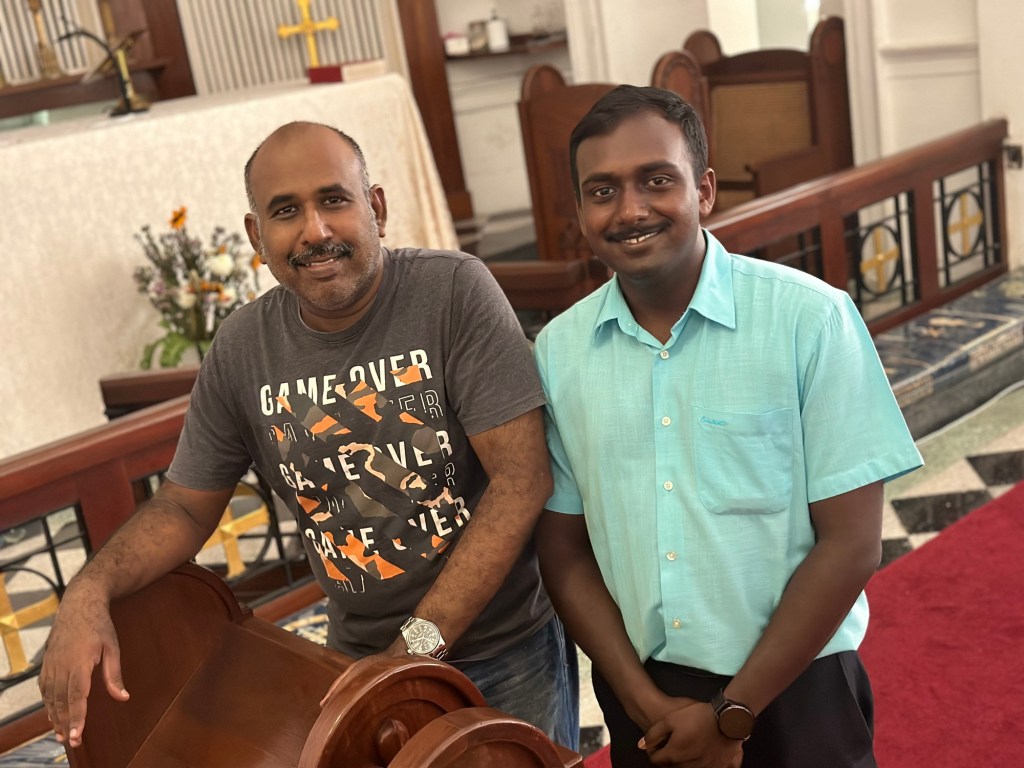
From left: Leonard, Hannah, Jason & Matthew (courtesy pix Leonard Selva Gurunathan)
For many young musicians, the pipe organ is a daunting and complex instrument. With its massive size, myriad of keys and stops, and powerful sound, it can be intimidating for even the most seasoned musician. However, for those who are willing to put in the time and effort, the pipe organ can be an incredibly rewarding and fulfilling instrument to play.
Leonard on the pipe organ at St George’s Church
Young musicians Matthew Arwinraj Jaya Paul, Jason William and Hannah Thoraisingam seem to have found a good teacher in Leonard Selva Gurunathan in helping them navigate the complexities of this intricate instrument.
A free lunchtime pipe organ recital yesterday at St George’s Church in Penang was a good show that they are on the way to becoming very proficient pipe organ players.
One of the most inspiring things about learning to play the pipe organ is the rich history and tradition that surrounds this instrument.
Matthew with proud grandmum, Rani Rajamoney
The pipe organ has been a staple of Western music for centuries, and has been used in churches, concert halls, and even in popular music.
By mastering this organ, this group of young people are well on their way to being a part of this rich tradition and carrying on a legacy that spans generations.
Leonard and Jason
The latest edition of the George Town Festival has provided an opportunity for Leonard and young pipe organists in Penang to showcase their talent and inspire audiences from all walks of life with their passion for music.
If you happen to be a young pipe organist or nursing aspirations to be one (regardless of age!) there is still one more free recital during this annual arts festival to enjoy and be further inspired by.
See you next Saturday (July 27) at 1pm in the Church of the Assumption along Lebuh Farquhar.
Church of the Assumption
This heritage Roman Catholic church, is home to the country’s oldest pipe organ, where its resident organist and fierce custodian of the instrument, is Leonard.
Join him and his pipe organists as they take you on a (keyboard) journey of Malaysian music and those from around the world, as they try and inspire more people in Penang and elsewhere to make a home for and support the upkeep of pipe organs, while placing Malaysian talents on the world map of pipe organs.
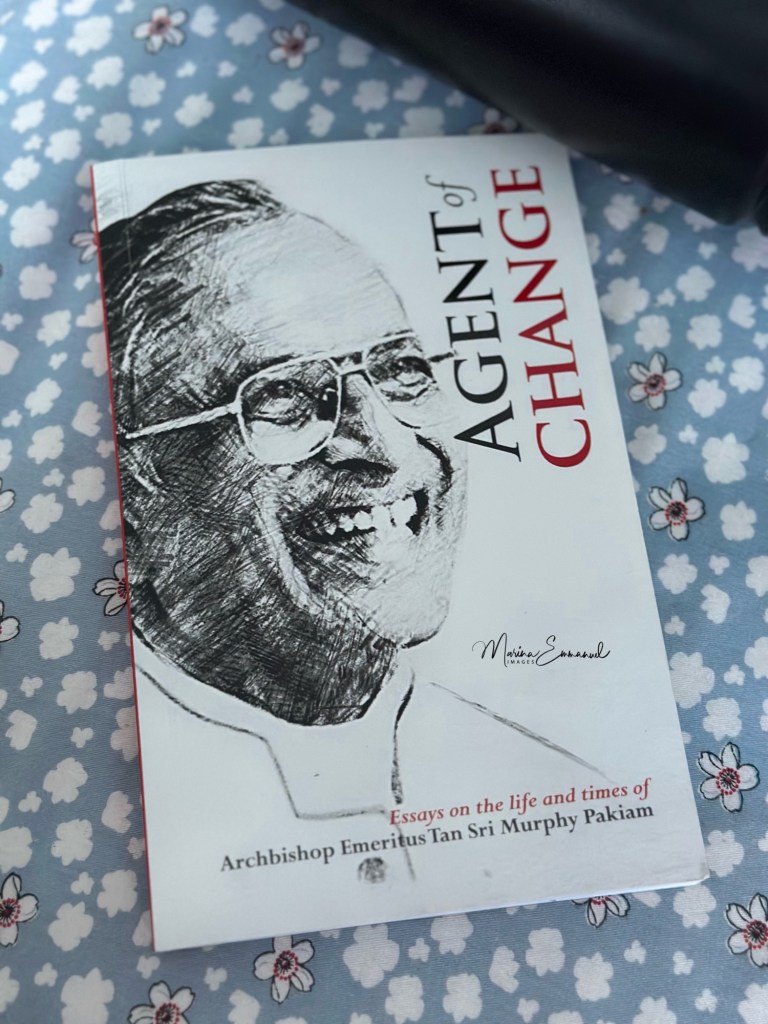
A chapter is dedicated to Sybil in the book “Agent of Change – Essays on the life and times of Archbishop Emeritus Tan Sri Murphy Pakiam”
Malaysia has a candidate for sainthood. While many claim they have no clue of who Sybil Medan Kathigasu is, others have brief recollections of her in their History textbooks.
Sybil is also the only Malayan woman to receive the British Crown’s George Medal for covertly supplying medicine, medical services and refuge to resistance fighters from her home (a shophouse in Papan, Perak) for years during World War II.
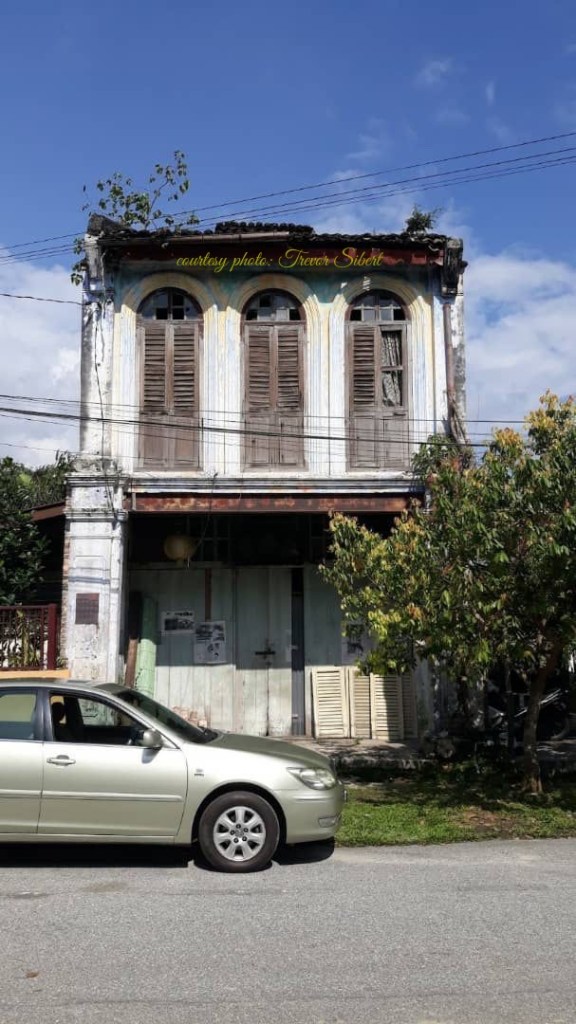
The shophouse in Papan, Perak where Sybil worked and lived.
Her legacy is also found in Roman Catholic cathecism books, a movie (Sybil Kathigasu – Apa Dosa Ku), a book she penned “No Dram of Mercy”, while a chapter is dedicated to her in a new book, “Agent of Change – Essays on the life and times of Archbishop Emeritus Tan Sri Murphy Pakiam.”
(The former archbishop who grew up in Batu Gajah, Perak where Sybil was incarcerated during the war, had a strong desire for her to become Malaysia’s first saint, because of his growing years and stories of her faith and courage which were relayed by family and friends.)
“Apart from my dad serving her medically while she was in prison, I feel strongly that Sybil should be made a saint as she has served as a faithful person who sacrificed so many things for the church’s sake and the community around her at the time can attest to it,” Archbishop Emeritus Murphy says in “Agent of Change.”
“Why I chose Sybil,” says Cardinal Sebastian Francis in the book , “is because she is a woman, a lay person (and not a cleric), a wife and mother and also a professional.”
“For the Catholic church,” notes Sebastian, who is also Bishop of Penang, “we are unique and are not taken up by stories of courage.”
“We (the Penang Diocese) have commenced with the collection of data and initial steps for the process of canonisation of (a saint from our soil).
“It is pretty obvious from the initial data that I have received and other sources of information that Sybil was a courageous freedom fighting heroine and we are reasonably convinced that we should proceed with (her canonization).”
His Eminence Cardinal Datuk Seri Sebastian Francis (left) is calling for Sybil’s beatification and canonisation
A movie titled “Sybil” is also reportedly in the making, while an opera “Solace of Papan” is set to open in Selangor this month.
The road to sainthood is a long, complex and expensive one and all help is needed in crafting a memorable and meaningful “brand” for potential candidates.
What qualities and characteristics do or did our potential saint embody? How can we best represent Sybil’s life and achievements through branding?